
What Counts as an Anterior Open Bite
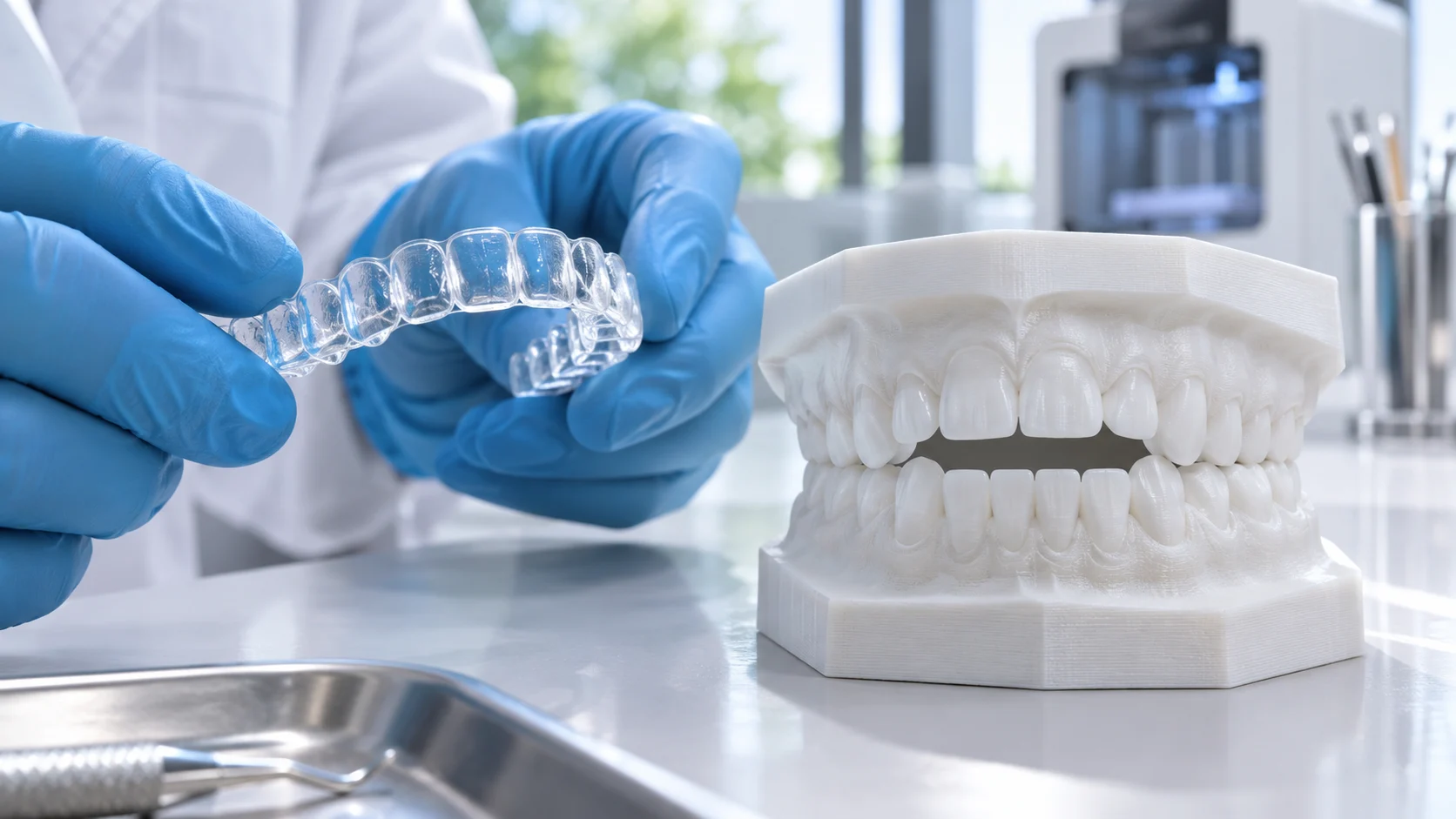
An anterior open bite is a lack of vertical overlap between the upper and lower incisors when the posterior teeth are in occlusion. It ranges from incisors that only just miss each other to a gap of several millimeters that leaves the patient biting on the molars and premolars alone. A 2025 scoping review of aligner treatment grades open bites as mild up to −2 mm, moderate at −3 to −4 mm, and severe beyond that.
This guide is for dentists, orthodontists and DSO clinical leads who plan open bite cases with clear aligners. It covers diagnosis, the mechanics aligners use to close the bite, what cephalometric studies report, which cases suit aligners alone, and how to plan, stage and retain the correction.
- Find the cause before you plan. Dental, skeletal and habit-driven open bites need different plans, and an active tongue or digit habit can undo any of them.
- Most of the closure comes from the incisors. Studies of adults treated with aligners report incisor extrusion and retroclination as the main mechanisms, with less than a millimeter of molar intrusion on average.
- Let the smile decide which incisors move. Upper incisor display at rest and on smiling tells you how much upper extrusion the face can take.
- Plan for vertical shortfall. Extrusion has been one of the least predictable aligner movements, so use attachments, overcorrection and a mid-treatment check.
- Treat retention as part of the plan. Open bites can reopen after treatment, so agree on habit control and retainers before the first aligner is made.
Diagnose Before You Plan
The same overbite measurement can come from very different problems, and the cause decides the plan. Before you request a setup, decide which group the patient belongs to:
- Dental open bite. The vertical skeletal pattern is normal, and the gap comes from under-erupted or proclined incisors. These patients are the best candidates for aligners alone.
- Skeletal open bite. Lower anterior face height is increased and the mandibular plane is steep, often with lip strain on closure. Tooth movement can camouflage mild cases; larger discrepancies need skeletal anchorage or a surgical opinion.
- Habit-driven open bite. Digit sucking, a forward tongue posture or tongue thrust, and mouth breathing keep the incisors apart. Unless the habit stops, the bite tends to reopen.
Many patients show more than one of these, so record the findings for each.
Records that change the plan
- Photos at rest and on full smile, with upper incisor display measured in millimeters.
- A lateral cephalogram to assess the mandibular plane angle, lower face height and incisor inclination.
- Full-arch scans with an accurate bite in maximum intercuspation, since the posterior contacts carry the whole occlusion.
- A tongue and swallowing assessment, plus a history of mouth breathing or enlarged tonsils where relevant.
- Notes on joint symptoms and posterior wear, because a long-standing open bite loads the back teeth.
Our guide to STL file requirements covers scan quality and bite registration, and our article on why aligner cases get rejected lists the records that most often hold a case up.
How Clear Aligners Close an Open Bite
Aligners have four ways to create overbite, and most plans combine two or more of them.
| Mechanism | How it works | Best suited to |
|---|---|---|
| Incisor extrusion | Upper or lower incisors are moved occlusally, usually with attachments that give the aligner a surface to engage | Dental open bites with little upper incisor display |
| Retroclination | Retracting proclined incisors brings their edges down and toward each other, closing the bite without true extrusion | Proclined or spaced incisors, or cases where IPR creates room |
| Posterior intrusion | Molars and premolars are intruded, with some help from the aligner material covering the occlusal surfaces | Mild skeletal patterns and patients who should not show more upper incisor |
| Mandibular autorotation | Posterior intrusion lets the mandible rotate closed, which also shortens the lower face | Long-face patients, most reliably with skeletal anchorage |
Because the incisors sit well in front of the molars, a small change at the back produces a larger change at the front. That is why posterior intrusion appeals in long-face patients, and also why it depends so much on anchorage.
What the Studies Show
The evidence on aligners for open bite is retrospective and comes mostly from adults treated with one commercial aligner system, so read it as a guide to what usually happens rather than a guarantee. Across studies, the pattern is consistent.
| Study | Patients | Main finding |
|---|---|---|
| Moshiri et al., 2017 | 30 adults; mean open bite 1.8 mm | Correction was attributed mainly to lower molar intrusion and counterclockwise rotation of the mandible |
| Harris et al., 2020 | 45 adults; mean overbite −1.2 mm | Upper incisors extruded about 1.5 mm and were retracted; lower incisors extruded; upper and lower molars intruded, with slight autorotation |
| Suh et al., 2022 | 69 adults, 50 with a skeletal open bite | Positive overbite in 94%; mean overbite gain 3.3 mm; upper molars intruded about 0.4 mm with aligners alone |
| Steele et al., 2022 | 29 aligner and 24 miniplate patients | Both groups improved; aligners mainly through incisor extrusion, miniplate intrusion through 1.5 mm more molar intrusion and mandibular autorotation |
| Pokorná et al., 2022 | 30 patients; mean treatment 20 months | Upper molars intruded 0.66 to 0.83 mm; incisors ended more retroclined than planned; little change in facial profile expected |
Two points follow for planning. First, aligners alone usually intrude molars by less than a millimeter, so a plan that relies on large posterior intrusion needs skeletal anchorage. Second, most of the closure comes from the incisors, which makes smile esthetics the main limit on how far you can go.
The 2025 scoping review of 30 studies reached a similar view: aligners can produce measurable incisor extrusion and posterior intrusion when attachments and mini-screws are used, but precise vertical control is still difficult and long-term stability data are limited.
Vertical movements tend to fall short
Planned and achieved movements often differ. A systematic review in The Angle Orthodontist found extrusion to be the least accurate aligner movement, at about 30% of the planned amount, with the upper central incisors lowest at about 18%. Those figures come largely from earlier aligner generations. A 2023 systematic review of upper incisor movements reported much higher extrusion accuracy in some studies, but it also noted that refinements were often needed. Plan on the incisors extruding less than the setup shows. Our guide to tooth movement biomechanics explains why some movements track better than others.
Send us your next open bite case
Our planning team will stage the vertical correction, place extrusion attachments and build in overcorrection, then return a 3D setup for your review.
[email protected]Which Open Bite Cases Suit Aligners
Use severity, cause and facial pattern together. As a starting point:
| Case | Aligners alone? | What to add |
|---|---|---|
| Mild dental open bite (to −2 mm) | Usually | Extrusion attachments, overcorrection and habit control |
| Moderate open bite (−3 to −4 mm) | Often, with careful planning | Vertical elastics, early posterior intrusion and possibly TADs |
| Proclined, spaced incisors | Usually | Retraction and space closure for relative extrusion |
| Skeletal open bite with a steep mandibular plane | Mild cases only, as camouflage | TADs for molar intrusion; consider an orthodontic referral |
| Severe open bite or marked facial imbalance | No | An orthognathic surgery opinion, sometimes with a surgery-first approach |
| Active digit or tongue habit | Not until the habit is managed | Habit cessation and a myofunctional therapy referral |
A skeletal pattern does not rule aligners out. In the Suh et al. study, 50 of the 69 patients had a mandibular plane angle of 38 degrees or more, and the group as a whole reached a positive overbite in 94% of cases. What a skeletal pattern changes is how much of the correction can come from the incisors before the smile and lip support suffer.
Planning the Digital Setup
Write the vertical plan into the prescription instead of leaving it to the setup designer. These steps work for most dental and mild skeletal cases.
- Set the vertical goal from the face.Choose the target overbite and which incisors will move, using upper incisor display at rest and on smiling. If the upper incisors already show well, extrude the lower incisors or intrude posteriorly instead.
- Name the mechanism for each arch.For example: “extrude upper laterals 1 mm, retract and extrude lower incisors with IPR, intrude upper second molars.” A clear instruction gives you a setup you can check against it.
- Create space where retraction is planned.IPR or closure of existing spaces lets proclined incisors tip back and drop into contact. Check the IPR amounts and sequence before approval.
- Place extrusion attachments.Request attachments on every tooth that must extrude, including laterals and canines with short clinical crowns.
- Stage vertical movements early and in small steps.Start incisor extrusion and posterior intrusion early, keep the change per aligner small, and avoid combining large rotations with extrusion on the same tooth.
- Build in overcorrection.Finish the setup with more overbite than your clinical target, since vertical movements tend to fall short.
- Check the final occlusion.Confirm that the setup ends with even posterior contacts and anterior guidance, not a closed anterior bite with the premolars out of contact.
- Schedule a vertical check.Measure overbite at a set aligner number. If the incisors are lagging, add elastics or request a refinement early, before the remaining aligners drift further from the plan.
Before you approve, run through our checklist for reviewing a 3D treatment setup, and see how attachments, IPR and staging affect predictability.
Attachments, Elastics and TADs
- Attachments. Without them, an aligner has little to push against when it extrudes a tooth. In a 2023 laboratory study, attachments consistently generated extrusive forces on incisors, although every approach tested also produced unwanted forces and moments.
- Vertical elastics. Buttons bonded to the incisors or canines, with matching cut-outs in the aligners, allow box or triangle elastics to support extrusion. Use them for a defined period and check wear at each visit.
- Temporary anchorage devices. Mini-screws let you intrude molars further than aligners usually achieve on their own, and they are the usual route for skeletal open bites treated without surgery. In Steele et al., miniplate-supported intrusion produced 1.5 mm more upper molar intrusion than aligners, with counterclockwise mandibular rotation and reduced anterior face height.
- Full seating. Vertical movements depend on a fully seated aligner. Ask patients to seat each new aligner completely, and check the fit over the incisors at every review.
Retention and Relapse
Open bites can reopen, and the stability data should shape the consent conversation. A 2011 meta-analysis of 21 case series found stability above 75% at one year or more for both surgical and nonsurgical treatment, which also means some patients lost part of the correction. For molar intrusion with skeletal anchorage, a 2020 meta-analysis found that overbite relapsed by about 1.2 mm on average, with relapse of about 12% of the intrusion in upper molars and 27% in lower molars. Long-term data specific to aligners are still limited.
- Treat the cause. Habit control and tongue-posture work should start before treatment and continue after it.
- Plan retainers before the final aligner. Decide on fixed, removable or combined retention, and how long full-time wear will last, when you approve the setup.
- Measure overbite at retention reviews. Recording it at each visit shows vertical relapse early, while it is still small.
Our clear aligner retention protocol covers retainer choice and review intervals in more detail.
Common Planning Mistakes
- Extruding upper incisors in a patient who already shows plenty of tooth or gum when smiling.
- Treating a skeletal open bite as dental and expecting aligners alone to rotate the mandible closed.
- Leaving out extrusion attachments, then blaming patient wear when the incisors do not track.
- Approving a setup with no overcorrection for the vertical movements.
- Ignoring an active tongue or digit habit because the setup looks good.
- Finishing with posterior teeth out of contact after closing the anterior bite.
- Having no plan for vertical relapse once the last aligner is delivered.
How Clear Moves Aligners Helps With Open Bite Cases
Clear Moves Aligners is a clear aligner manufacturer and treatment planning partner for clinics, dental labs, DSOs and aligner brands. Our aligners are FDA-cleared under 510(k) K241137 (product code NXC), and we are ISO 13485 certified, CE-marked under the EU MDR, MHRA-registered and TGA-listed, with materials tested for biocompatibility to ISO 10993.
For open bite cases, our planning team stages incisor extrusion, retraction and posterior intrusion to the vertical goal you set, places extrusion attachments and elastic cut-outs where needed, and builds in overcorrection for you to review. We typically return 3D setups in 24 to 48 hours and revise them until you approve, and aligners typically ship by tracked express courier within 10 to 15 business days of approval. You can use our treatment planning service on its own or as part of full manufacturing. For related vertical and sagittal planning, see our clinical guides to deep bite correction and Class II correction.
Frequently Asked Questions
Can clear aligners correct an anterior open bite?
How do aligners close an open bite?
Do I need attachments for open bite correction?
When should I add TADs to an aligner plan?
How long does open bite treatment with aligners take?
Is open bite correction stable?
Worldwide