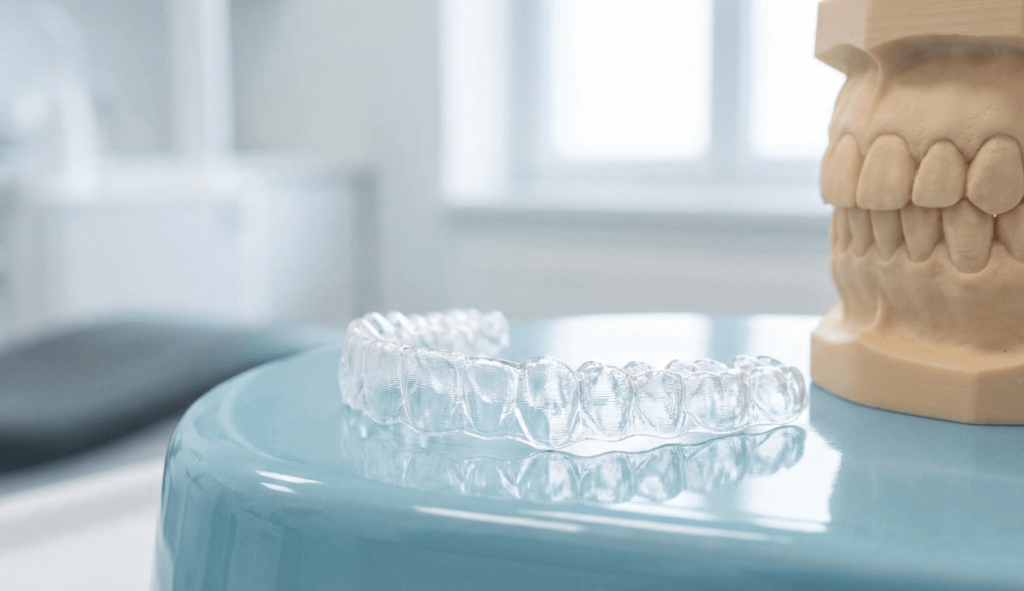
Short answer: In 2027, invisible braces (clear aligners) in Pakistan typically cost between PKR 90,000 and PKR 800,000+. Most patients with mild to moderate cases pay PKR 180,000 to 350,000. Your final price depends on four things: how complex your case is, which aligner system is used, who plans your treatment, and what the package includes.
If you’ve been searching for “aligners price in Pakistan,” you’ve probably noticed that quotes vary widely. Two clinics on the same street can quote numbers PKR 200,000 apart. This guide explains why, so you can compare quotes properly and avoid paying for the wrong thing. We don’t favour any single manufacturer here.
| Aligner Category | Estimated Cost (PKR) | Typical Treatment Time | Best For |
|---|---|---|---|
| Local / In-House Lab | 90,000 – 180,000 | 4 – 9 months | Minor crowding, small gaps, relapse after braces |
| Mid-Tier (Regional Brands) | 180,000 – 350,000 | 6 – 15 months | Moderate crowding or spacing, mild bite issues |
| Premium (International Systems) | 350,000 – 800,000+ | 12 – 24 months | Complex bites, severe crowding, rotations |
These are estimated market ranges for 2027. Your actual invisible teeth braces price depends on your city, your clinic, and a clinical assessment of your case.
Three trends are shaping teeth aligner prices in Pakistan heading into 2027.
The exchange rate still drives the premium tier. International aligner systems are manufactured abroad and priced in foreign currency. Import duties and shipping are added on top. When the rupee weakens, premium quotes rise, even if nothing else about the treatment changes.
Local manufacturing has matured. More Pakistani clinics now work with domestic aligner labs. These labs use 3D printing, medical-grade thermoforming materials, and the same kind of digital treatment planning used by international brands. This has narrowed the gap between local and premium options for mild to moderate cases.
Digital workflows are now standard. Intraoral 3D scanners are now common in clinics in major cities. They have largely replaced messy physical impressions and made treatment planning faster.
Many clinics in Lahore, Karachi, Islamabad, and Rawalpindi now make aligners through in-house labs or local manufacturing partners.
Pros: This is the most affordable planned treatment. Turnaround is fast because nothing is shipped from abroad, and replacement trays are easier to get.
Cons: Material quality and planning software vary a lot between labs. Some local options aren’t suited to complex root movements or significant bite correction.
Verdict: A good choice for minor cosmetic corrections and for patients whose teeth shifted after earlier braces. Just confirm the lab uses medical-grade material and that a qualified clinician approves the digital plan.
This tier covers established aligner companies operating across Asia and the Middle East that have distribution in Pakistan.
Pros: They have a proven track record, better planning software, and are usually supervised by an orthodontist or a dentist trained in aligners.
Cons: They cost more than local labs, and trays may take longer to arrive.
Verdict: The sweet spot for most patients. You get a good balance of cost, predictability, and results for moderate cases.
The global market leaders sit in this tier. Their pricing follows foreign currency, so it moves with the exchange rate.
Pros: Proprietary materials and strong support for complex tooth movements. The market leader reports around 23 million patients treated worldwide, one of the largest treated-case histories in orthodontics.
Cons: The highest cost, longer shipping times, and the top of the range often reflects clinic brand positioning as much as treatment needs.
Verdict: Worth it for complex bite corrections, severe crowding, or patients who want the strongest brand assurance.
The biggest factor in your quote isn’t the brand. It’s how much your teeth need to move.
| Case Type | Typical Duration | Approx. Trays | What It Involves |
|---|---|---|---|
| Mild | 4 – 8 months | 10 – 20 | Minor crowding, small gaps, relapse |
| Moderate | 8 – 15 months | 20 – 35 | Noticeable crowding or spacing, mild overbite |
| Complex | 15 – 24+ months | 35+ | Deep bite, crossbite, open bite, Class II/III issues, extraction cases |
Durations and tray counts are approximate. Aligners are usually changed every 1 to 2 weeks, and your clinician will confirm the numbers for your case.
More complex cases usually need attachments (small tooth-coloured bumps bonded to teeth that help the aligners grip) and interproximal reduction (gently polishing a small amount of enamel between teeth to make space). Many also need one or more refinement rounds. Each of these adds material cost and chair time.
Dentist vs. orthodontist. General dentists often quote less. Orthodontists and highly experienced aligner providers usually charge more. For anything beyond a minor cosmetic case, specialist planning is worth paying for, because a good result means a healthy bite, not just straight front teeth.
City and clinic location. Clinics in premium areas such as DHA, Gulberg, Clifton, and F-7 have higher overheads, and their prices reflect that. The same treatment can cost noticeably less in other parts of the same city.
What’s included in the package. One clinic’s PKR 250,000 all-inclusive package can end up cheaper than another’s PKR 200,000 base price once extras are added.
Before you commit, ask whether each of these is included or charged separately:
| Item | Typical Extra Cost (PKR) |
|---|---|
| Consultation and 3D scan | 1,000 – 10,000 (some clinics offer a free scan) |
| X-rays (OPG / cephalometric) | 500 – 5,000 per X-ray |
| Refinement aligners | Varies: included at some clinics, charged at others |
| Lost or broken tray replacement | 5,000 – 15,000 per tray |
| Follow-up visits | 1,000 – 5,000 per visit |
| Retainers after treatment | 10,000 – 40,000 per arch (most patients need both) |
Retainers deserve special attention. Without them, teeth tend to drift back, and fixing a relapse means paying for treatment again.
Some clinics and online sellers advertise “removable braces” or “invisible braces” for PKR 30,000 to 80,000. In many cases this is a single generic appliance, not a series of trays planned from a 3D scan. The US FDA has warned that clear aligners used without proper professional supervision can lead to an uneven bite, unintended tooth movement, pain, and even tooth loss.
A legitimate clear aligner treatment always includes:
If any of these are missing, the low price isn’t a saving.
| Clear Aligners | Metal Braces | |
|---|---|---|
| Typical Cost (PKR) | 90,000 – 800,000+ | 60,000 – 180,000 (private clinics) |
| Visibility | Nearly invisible | Clearly visible |
| Food Restrictions | None (trays are removed to eat) | Avoid hard and sticky foods |
| Oral Hygiene | Brush and floss normally | Harder around brackets |
| Emergency Visits | Rare | More common (broken brackets, poking wires) |
| Best For | Mild to moderate cases; some complex cases with an experienced provider | All cases; still the standard for the most complex |
Metal braces are cheaper upfront. Government and teaching dental hospitals often offer braces at subsidised rates, though waiting times are longer. Aligners are more comfortable and discreet, and studies show they need fewer emergency visits. One requirement matters most: aligners must be worn 20 to 22 hours a day. If you won’t commit to that, braces may be the better investment.
For a detailed side-by-side, see our guide to invisible aligners vs traditional braces in Pakistan.
Many clinics in Pakistan offer instalment plans that spread the cost across your treatment period, usually with an upfront deposit. Some also accept credit card instalments through bank partnerships. When comparing plans, check for:
A clinic that answers these clearly and puts the quote in writing is usually a clinic you can trust. Our guide on how to choose the best invisible aligners in Pakistan covers this in more detail.
If you’re a dentist or clinic owner looking to offer clear aligners without the cost of premium international systems, a white-label aligner partner can help. Clear Moves Aligners provides orthodontic treatment planning and white-label clear aligner manufacturing, so you can offer your patients a competitive invisible braces price in Pakistan while keeping full clinical control.
Learn about our clinic partnership program →
What is the invisible braces price in Pakistan in 2027?
Clear aligner treatment typically costs PKR 90,000 to 800,000+. Most mild to moderate cases fall between PKR 180,000 and 350,000, depending on complexity, aligner system, and clinic.
Why are some aligner quotes so much cheaper than others?
Cheaper quotes usually mean local lab aligners, simpler cases, or packages that leave out extras like retainers and refinements. Quotes far below PKR 80,000 may not be a properly planned treatment at all.
Are clear aligners more expensive than metal braces in Pakistan?
Usually, yes. Metal braces typically cost PKR 60,000 to 180,000 at private clinics, and teaching hospitals often charge less. Mild aligner cases using local labs can come close to braces pricing.
Can I pay for aligners in instalments?
Yes. Many clinics offer instalment plans spread across the treatment period, and some accept credit card instalments. Check for any interest or admin fees.
Do I need retainers after aligner treatment?
Yes. Retainers are essential to stop teeth shifting back. They usually cost PKR 10,000 to 40,000 per arch if they aren’t included in your package, and most patients need both arches.
How long does clear aligner treatment take?
Mild cases can finish in 4 to 8 months. Moderate cases take 8 to 15 months, and complex cases can take 24 months or more.
Are local aligners safe?
They can be, if they’re made from medical-grade material and planned and supervised by a qualified dentist or orthodontist. The problem is usually unsupervised or unplanned treatment, not local manufacturing itself.
The invisible braces price in Pakistan in 2027 ranges widely because the treatments themselves vary widely. A quick cosmetic touch-up and a two-year bite correction are not the same product. To compare quotes properly, match the aligner tier to your case, insist on an itemised quote, and make sure a licensed professional plans and supervises your treatment. Choosing on price alone is the most common way people end up paying twice.
This guide is for educational purposes only and is not medical advice. Please consult a qualified dental professional before starting any orthodontic treatment.
Going for a consultation? Don’t leave the clinic without asking these 7 critical questions.
It’s easy to get overwhelmed during a dental visit. Save this checklist to your phone and make sure you get clear answers before committing to a payment plan.
© 2026 Clear Moves Aligners All Rights Reserved 8 core digital marketing agency