
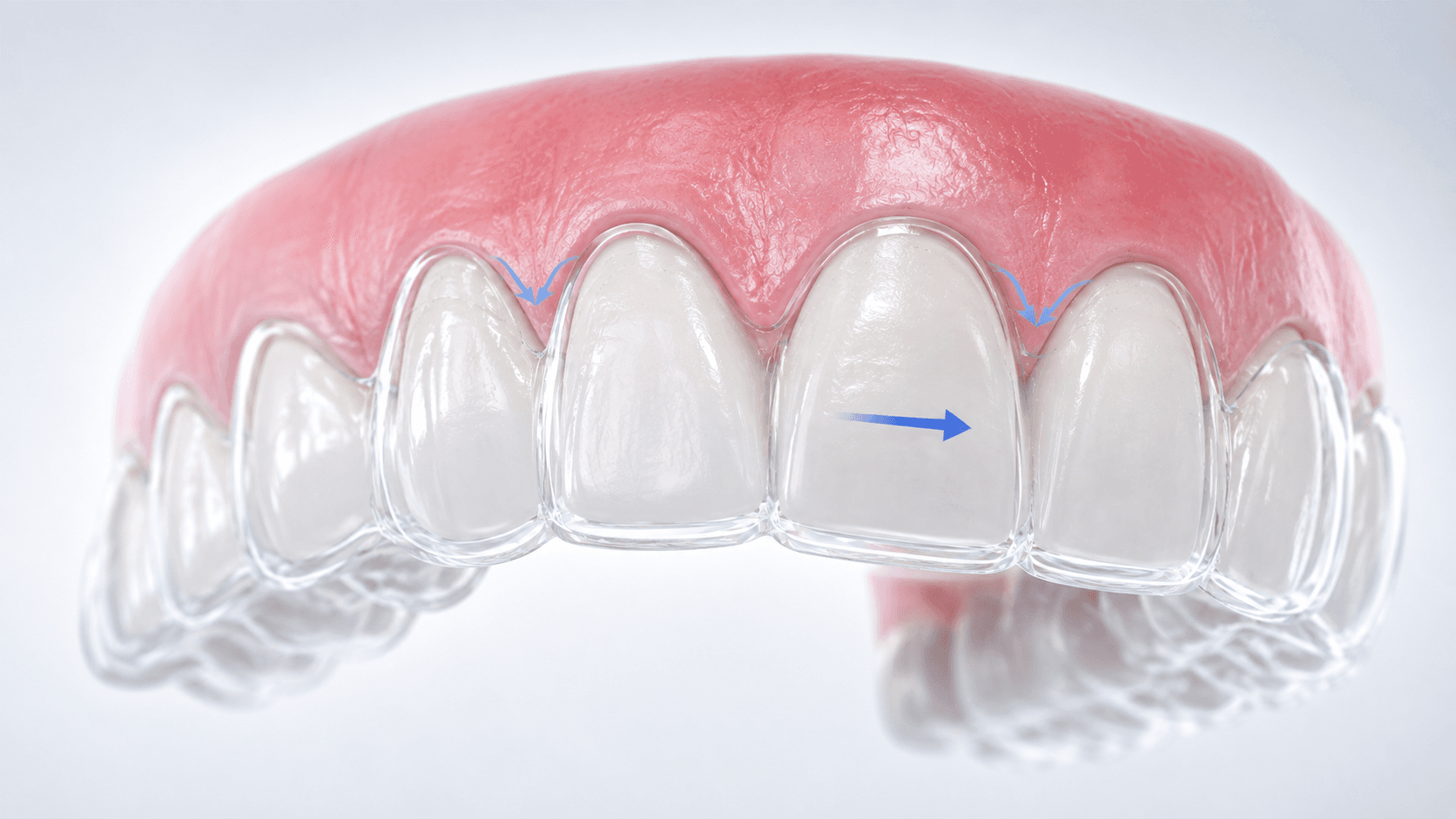
Alignment Is a Health Question, Not Just a Cosmetic One
Ask most patients why they are considering orthodontic treatment and the answer is about appearance. Ask a periodontist, a restorative dentist or an insurer's clinical assessor, and you get a different set of answers entirely — ones about plaque retention, occlusal load, enamel loss and the restorative work that follows twenty years later.
Both perspectives are legitimate. But the cosmetic framing has quietly become the dominant one, and it undersells what alignment does. The oral health benefits of straight teeth are real, measurable and, in some cases, the difference between a mouth that stays stable into a patient's sixties and one that requires progressively more restorative intervention from the forties onward.
It is worth being precise about the mechanism, because vague claims here have damaged the credibility of the whole argument. Straight teeth are not inherently more resistant to decay. Enamel does not become stronger because a tooth rotated eight degrees into position. What changes is access and load — how easily the surfaces can be cleaned, and how evenly biting force is distributed across the arch. Every genuine health benefit of orthodontic treatment traces back to one of those two variables.
Different malocclusions create different problems, and it is a mistake to treat them as one category. The table below maps the major presentations to their specific oral health consequence, which is also the structure this article follows.
| Malocclusion | Primary Oral Health Consequence | Mechanism | Further Reading |
|---|---|---|---|
| Crowding & rotation | Gingival inflammation, interproximal decay | Contact areas inaccessible to brush and floss | Understanding Misaligned Teeth |
| Deep bite | Incisal wear, palatal soft tissue trauma | Excessive vertical overlap concentrates force on anterior teeth | Deep Bite Correction |
| Crossbite | Localised recession, mandibular shift, asymmetric wear | Teeth occlude outside their intended buccolingual relationship | Crossbite Correction |
| Open bite | Impaired incising, overload of posterior teeth | Anterior teeth never contact, so all function shifts distally | Open Bite vs Crossbite |
| Spacing & diastema | Food impaction, papillary inflammation | Absent contact points allow debris to lodge against the gingiva | Spacing and Gap Teeth |
For a broader view of which presentations respond to aligner therapy at all, our guide to the five orthodontic problems clear aligners can fix covers case selection in more depth.
Crowding, Plaque and the Periodontal Argument
Crowding is the most common malocclusion and the one with the clearest hygiene consequence. When teeth overlap, the interproximal surfaces — the contact areas between adjacent teeth — rotate out of the plane that floss can pass through cleanly. A patient can floss diligently and still leave plaque behind, simply because the geometry does not allow the floss to wrap the tooth surface properly.
That plaque matures. Within days it organises into a biofilm that provokes gingival inflammation, and in susceptible patients, that inflammation progresses to attachment loss and bone resorption. The overlapped areas also accumulate calculus faster, because the same inaccessibility that protects plaque from a toothbrush protects it from disruption long enough to mineralise.
How Strong Is the Evidence, Really?
This deserves an honest answer, because it is routinely overstated in patient marketing. The association between crowding and periodontal disease is consistent but modest. Crowding is a risk modifier, not a cause. Plaque is the cause. A patient with significant crowding and excellent hygiene will generally have healthier gums than a patient with a textbook arch who brushes for forty seconds and never flosses.
What the evidence does support is that crowding raises the effort threshold required to achieve a given standard of plaque control. And because most people do not maintain heroic hygiene indefinitely, raising that threshold reliably produces worse outcomes across a population, even if any individual patient might beat the odds.
There is a second-order benefit that gets discussed less often. Once teeth are aligned, hygiene becomes visibly more effective, and patients notice. Bleeding on brushing stops. The mouth feels cleaner. That feedback loop tends to reinforce better habits, which compounds the original benefit in a way that is difficult to capture in a clinical trial but shows up clearly in long-term recall patterns.
How Bite Problems Wear Teeth Down
If the crowding argument is about cleaning, the bite argument is about force. And force is where the irreversible damage happens, because enamel does not grow back.
The adult dentition is designed to distribute occlusal load across many teeth simultaneously, with the posterior teeth absorbing the bulk of vertical force and the anterior teeth guiding lateral movement. When the bite relationship is disturbed, that distribution breaks down and a small number of teeth absorb loads they were never structured to handle — thousands of times a day, for decades.
Deep Bite: Anterior Overload
In a deep bite, the upper incisors cover the lower incisors excessively. Two things follow. The lower incisal edges wear against the palatal surfaces of the upper teeth, flattening and shortening over time. And in severe cases, the lower incisors contact the palatal soft tissue directly, producing chronic trauma to the gingiva behind the upper front teeth.
The clinical picture in an untreated deep bite patient at fifty is familiar to any restorative dentist: shortened, squared-off lower incisors, thinned palatal enamel on the uppers, and sensitivity. The restorative work required at that point is substantial and would largely have been avoidable. Our deep bite correction guide covers the intrusion and bite ramp mechanics used to open the bite before that wear accumulates.
Crossbite: Asymmetric Load and Recession
A crossbite places teeth outside their intended buccolingual relationship, and the consequences are localised but significant. Posterior crossbites frequently produce gingival recession on the affected teeth, because the abnormal force vector drives the tooth against thin buccal or lingual bone. Anterior crossbites can cause similar recession on the lower incisors.
More consequentially, many crossbites force the patient into a functional mandibular shift — the jaw deviates on closing to find a comfortable interdigitation. That shift becomes habitual and, over years, contributes to asymmetric muscle development and uneven wear across the arch. The crossbite correction protocol we use addresses both the dental position and the shift itself.
Open Bite: Posterior Overload and Functional Loss
An anterior open bite means the front teeth never meet. Patients often cannot bite through a sandwich or a strand of pasta cleanly — a functional deficit, not a cosmetic one. Because incising is impossible anteriorly, the entire mechanical burden shifts to the posterior teeth, which then wear and fracture at elevated rates. The comparison of open bite and crossbite presentations sets out how these differ diagnostically.
- Enamel loss is permanent: Unlike gingival inflammation, which resolves when plaque is controlled, worn enamel does not regenerate. Correction prevents further loss but cannot restore what is gone.
- Damage is cumulative and slow: Patients rarely notice wear year to year, which is precisely why it goes untreated until restorative intervention is the only remaining option.
- Restorative cost scales with delay: Correcting a deep bite in a thirty-year-old is orthodontic. Managing the same case at fifty-five often means orthodontics plus crowns or veneers.
- Function matters independently: An open bite patient who cannot incise properly has a measurable functional limitation regardless of how the smile looks.
Treating More Complex Cases in Your Practice?
Our clinical team provides 3D digital treatment planning for deep bite, crossbite and open bite cases — reviewed by licensed orthodontists before fabrication begins.
[email protected]Spacing, Food Impaction and Soft Tissue Health
Spacing is often assumed to be the harmless malocclusion — if teeth are further apart, surely they are easier to clean. In practice that holds only when the spacing is generalised and even. Localised spacing behaves quite differently.
Healthy adjacent teeth meet at a contact point, and that contact point does a specific job: it deflects food away from the gingival papilla during chewing. When the contact point is absent or incomplete, food is driven directly into the interdental space and lodges against the tissue. The result is chronic papillary inflammation, and in persistent cases, localised bone loss around the affected teeth.
Patients with this pattern describe it precisely — a particular gap that traps food at every meal, tender gum tissue in one spot that never quite settles, and a need to use interdental brushes in that area specifically. The rest of the mouth can be entirely healthy.
Closing the spaces restores the contact points and eliminates the impaction mechanism. Our guide to treating spacing and gap teeth with clear aligners covers the digital planning approach, including how contact quality is verified in the 3D setup before fabrication.
Jaw Function and the Systemic Question
Two claims regularly appear in orthodontic marketing that deserve careful handling: that malocclusion causes temporomandibular disorder, and that straightening teeth improves cardiovascular or systemic health. Neither is straightforwardly true, and overstating them undermines the arguments that are well supported.
Malocclusion and TMD
The relationship between occlusion and temporomandibular disorder was once considered direct and causal. Contemporary evidence does not support that. TMD is multifactorial — involving parafunctional habits, joint morphology, psychosocial stress and pain sensitivity — and occlusion plays a smaller role than was assumed for decades. Orthodontic treatment should not be presented as a treatment for TMD.
What can reasonably be said is narrower: specific occlusal situations, particularly a crossbite producing a functional mandibular shift, force the jaw into a habitual position it would not otherwise adopt. Correcting that shift is a defensible clinical objective on its own terms, independent of any TMD claim.
The Systemic Health Link
Periodontal disease is associated with cardiovascular disease, diabetes and adverse pregnancy outcomes. That association is well established. The chain from orthodontic treatment to systemic outcome, however, is long: alignment improves hygiene access, better hygiene access reduces periodontal inflammation, and reduced periodontal inflammation is associated with better systemic markers.
Each link in that chain is supported. The chain as a whole has not been demonstrated end to end, and claiming that straightening teeth improves heart health is a step further than the evidence permits. The honest version is that orthodontic treatment supports periodontal health, and periodontal health matters systemically. That statement is defensible and still persuasive.
What Alignment Actually Changes — And What It Doesn't
Setting expectations accurately is what separates a satisfied patient from a disappointed one. Here is a clear accounting of both sides.
What Improves
Hygiene access. Interproximal surfaces become reachable with floss and interdental brushes. Plaque control becomes achievable with normal effort rather than exceptional effort. This is the single most consequential change.
Load distribution. Occlusal force spreads across the arch as intended rather than concentrating on a few overloaded teeth. Further enamel wear slows substantially.
Function. Patients with open bites regain the ability to incise. Patients with functional shifts close into a stable position without deviating.
Restorative prognosis. Teeth in good positions are easier to restore predictably if they ever need crowns, bridges or implants. Orthodontics is frequently used specifically to create space and axial alignment before restorative work.
What Does Not Change
Existing damage. Enamel already lost to wear stays lost. Recession already present does not regrow. Bone lost to previous periodontal disease does not return with alignment.
Caries risk from diet and hygiene. A patient with a high-sugar diet and inconsistent brushing will still develop decay in a perfectly aligned arch.
Stability without retention. Teeth have a strong tendency to relapse toward their original positions. Every health benefit described in this article depends on the correction being maintained, which means retainers — indefinitely. Our complete retainer guide covers the protocols that hold results long term.
- The mechanism is access and load: Every genuine health benefit of alignment reduces to easier cleaning or better force distribution — not to some inherent property of straight teeth.
- Crowding is a risk modifier, not a cause: Plaque causes gum disease. Crowding makes plaque harder to remove, which matters most for patients whose hygiene is average rather than exceptional.
- Bite damage is the irreversible category: Enamel wear from deep bite, crossbite and open bite accumulates permanently, which is why timing matters more here than anywhere else.
- Overclaiming systemically backfires: The periodontal link is solid; the cardiovascular claim is not demonstrated end to end. The narrower statement is more credible and equally persuasive.
- Retention is not optional: Without long-term retainer wear, the health benefit reverses along with the alignment.
Why Clear Aligners Have a Hygiene Advantage During Treatment
If the goal of treatment is improved oral health, the appliance used to get there matters — not for the end result, which depends on the final tooth position, but for what happens to the gums and enamel during the eighteen months in between.
Fixed appliances create a well-documented problem. Brackets, wires and elastomeric modules are plaque retention sites that cannot be removed for cleaning. Gingival inflammation reliably increases during fixed appliance treatment, and white spot lesions — the early demineralisation marks that persist as permanent white patches on enamel — occur in a meaningful proportion of patients.
Removable aligners avoid that mechanism entirely. The patient takes the trays out, brushes and flosses normally, and puts them back. Nothing obstructs the toothbrush at any point in treatment. For a patient whose primary motivation is periodontal health, that is a substantive clinical argument rather than a convenience one.
The advantage is conditional, however, and the conditions matter.
- Trays out for anything except water Eating or drinking with aligners in traps sugars and acids directly against the enamel surface, where saliva cannot dilute or buffer them. This is the single most common way patients increase their decay risk during treatment.
- Brush before reinserting Reinserting trays over an unbrushed mouth seals plaque and food debris against the teeth for the next several hours. A quick brush, or at minimum a thorough rinse, before reinsertion resolves it.
- Maintain 20 to 22 hours of daily wear Wear time drives tracking. Poor tracking means the planned movements do not occur, which extends treatment and often requires refinements — prolonging the period during which the patient is in appliances at all.
- Clean the trays properly Aligners accumulate their own biofilm. Rinsing on removal and cleaning with a soft brush and cool water prevents the trays from becoming a bacterial reservoir reintroduced to the mouth twenty-two hours a day.
- Keep routine dental recalls during treatment Orthodontic appointments are not a substitute for hygiene visits. Patients should continue their normal recall interval throughout treatment so that any developing inflammation is caught early.
Compliance is the variable that determines whether the theoretical advantage becomes a real one. Our guide to patient compliance in aligner treatment covers the chairside approaches that improve wear time in practice, and our overview of how clear aligners move teeth explains why consistent wear is mechanically necessary rather than merely recommended.
For patients unsure whether their concern warrants a specialist referral or can be managed in general practice, the distinction between what a dentist and an orthodontist each handle is a useful starting point.
Frequently Asked Questions
Are straight teeth actually healthier, or is it purely cosmetic?
Can crooked teeth cause gum disease?
Does a deep bite damage your teeth over time?
Can straightening teeth help with bad breath?
Is orthodontic treatment ever medically necessary rather than elective?
Do clear aligners deliver the same oral health benefit as fixed braces?
Can oral health get worse during clear aligner treatment?
Worldwide

Build a Clinically Credible Aligner Programme
Clear Moves Aligners manufactures certified clear aligners and provides orthodontist-reviewed 3D treatment planning for dentists, labs and aligner brands worldwide.
[email protected]