
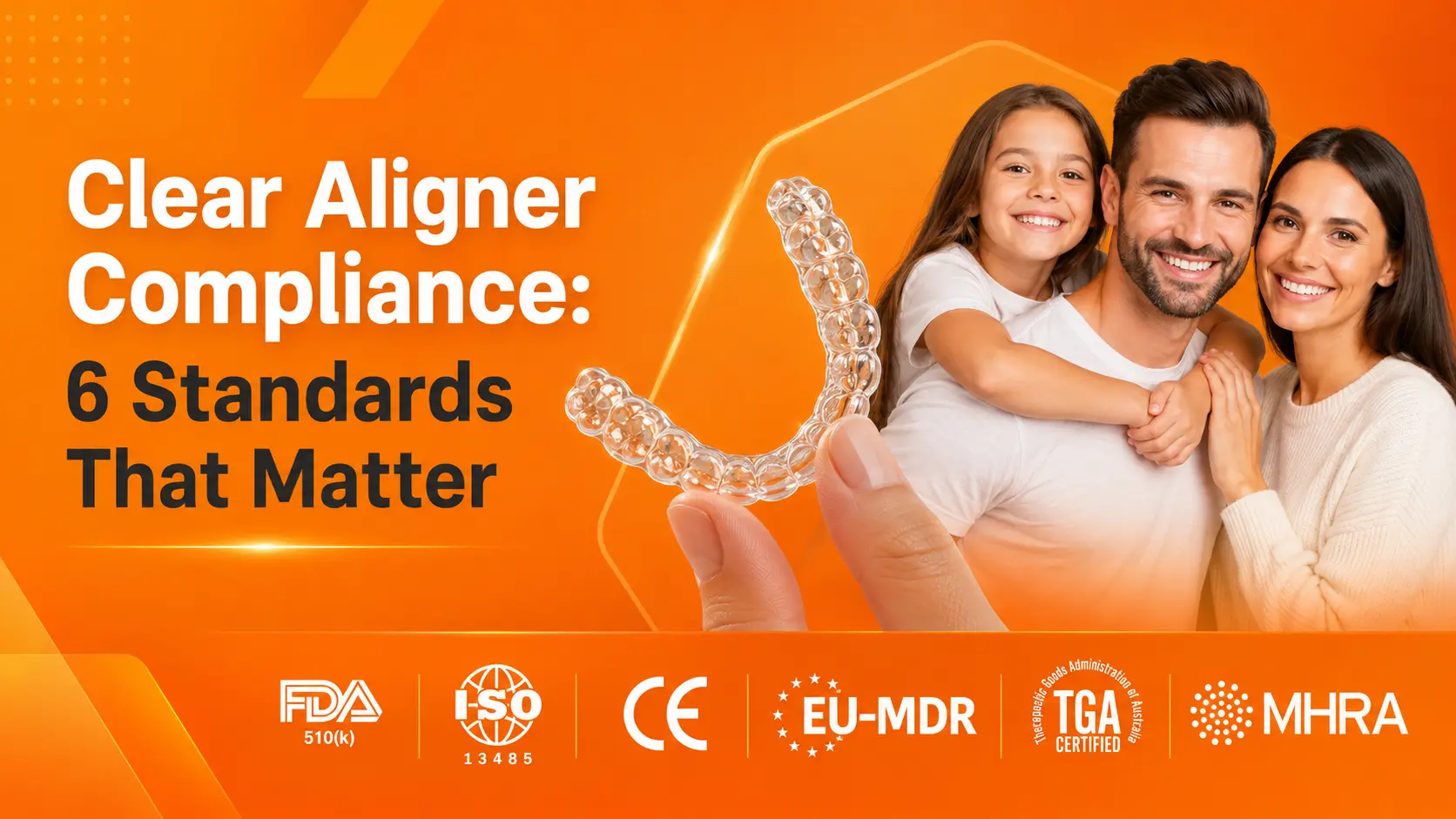
When evaluating a clear aligner manufacturer, the certifications on its website aren't marketing decoration — they're legal proof that the company is authorized to sell medical devices into specific markets. A manufacturer without the right certifications cannot lawfully supply clear aligners to clinicians, distributors, or patients in those regions, regardless of how good the product itself may be.
This guide explains the six certifications that define legitimacy in the global clear aligner industry: FDA 510(k) clearance in the United States, ISO 13485 quality management certification worldwide, CE marking under the EU Medical Device Regulation (EU MDR), MHRA registration in the United Kingdom, and TGA inclusion in Australia. Each serves a distinct purpose. Together, they form the regulatory baseline that separates compliant manufacturers from those operating in regulatory grey areas.
Why Clear Aligner Certifications Matter
Clear aligners are not consumer products. Across every major jurisdiction, they are classified as medical devices — Class II in the United States, Class IIa under the EU Medical Device Regulation, and as medium-risk devices in the UK and Australia. This classification triggers a mandatory regulatory pathway before any aligner can be legally placed on the market.
For clinicians, sourcing aligners from a certified manufacturer is a clinical and legal protection. Devices that haven't undergone the required review may not meet biocompatibility standards, may use undocumented materials, or may have been manufactured under quality systems that don't trace defects back to their source. For distributors and OEM buyers, certification status determines which markets they can legally serve and dictates the insurance, indemnification, and post-market surveillance obligations they inherit.
Certifications also signal something less visible but equally important: the existence of a documented quality management system, traceable materials, validated manufacturing processes, and a post-market surveillance program. These are the systems that detect and contain problems before they reach patients — and they're the systems regulators audit, not just paperwork.
Certifications at a Glance
Before diving into each certification in detail, here's how the six relate to one another by jurisdiction, scope, and what they actually certify.
| Certification | Jurisdiction | What It Certifies | Issuing Authority |
|---|---|---|---|
| FDA 510(k) | United States | Device is substantially equivalent to a legally marketed predicate | US Food & Drug Administration |
| ISO 13485 | International | Manufacturer operates a medical-device quality management system | Accredited certification body (e.g., BSI, TÜV, SGS) |
| CE Marking | European Union / EEA | Device conforms to EU MDR requirements | EU Notified Body |
| EU MDR | European Union / EEA | Underlying regulation governing CE marking for medical devices | European Commission (regulatory framework) |
| MHRA Registration | United Kingdom | Device is registered for legal supply in Great Britain | Medicines & Healthcare Products Regulatory Agency |
| TGA / ARTG Inclusion | Australia | Device is included in the Australian Register of Therapeutic Goods | Therapeutic Goods Administration |
FDA 510(k) — The US Standard
The FDA's 510(k) premarket notification is the regulatory pathway clear aligner manufacturers must complete before legally marketing aligners in the United States. A 510(k) is a premarket submission demonstrating that a device is substantially equivalent — meaning as safe and effective as — a legally marketed predicate device. For clear aligners, the predicate is typically an earlier aligner system already cleared by the FDA.
The 510(k) process requires the manufacturer to submit comprehensive documentation covering device design, materials, intended use, biocompatibility testing, sterilization (where applicable), and clinical or non-clinical performance data. The FDA reviews this submission and, if it concurs with the substantial equivalence claim, issues a clearance letter authorizing US commercial distribution.
Why 510(k) matters for clinicians
For US-based orthodontists and dentists, sourcing aligners from a 510(k)-cleared manufacturer is the baseline professional standard. It confirms the device has been reviewed against an FDA-recognized predicate and that the manufacturer has accepted the post-market obligations that come with clearance — including adverse event reporting, recalls when warranted, and quality system inspections. Clear Moves Aligners maintains current FDA 510(k) clearance and supplies the clearance letter to verified clinical and distribution partners on request.
The 2026 QMSR update
One important 2026 development: the FDA's new Quality Management System Regulation (QMSR) became effective on February 2, 2026. The QMSR amends the FDA's quality system requirements under 21 CFR Part 820 and incorporates ISO 13485:2016 by reference. In practical terms, this means the FDA's quality framework is now harmonized with the international ISO 13485 standard — significantly reducing duplicative audit burden for manufacturers certified to both.
ISO 13485 — The Quality Management System Backbone
ISO 13485 is the international standard for quality management systems specific to medical device manufacturers. Where FDA 510(k) clears a specific product for a specific market, ISO 13485 certifies that the entire manufacturing organization operates under a documented quality system designed for medical device production — covering design, development, production, storage, distribution, installation, and servicing.
The current version, ISO 13485:2016, places significant emphasis on risk-based decision making throughout the device lifecycle. Certification is issued by independent accredited certification bodies — names like BSI, TÜV SÜD, TÜV Rheinland, SGS, and DNV — following on-site audits of the manufacturer's quality system. Certificates are typically valid for three years with annual surveillance audits in between.
What ISO 13485 actually audits
An ISO 13485 audit examines whether the manufacturer has documented and consistently follows procedures for design control, supplier qualification, production validation, traceability, complaint handling, corrective and preventive action (CAPA), and management review. For a clear aligner manufacturer, this translates into questions like: Can you trace the exact resin batch used in a specific patient's aligners? Are your 3D printers validated and recalibrated on schedule? What is your documented response when a clinician reports a defect? An auditable answer to each is required to maintain certification.
Need Compliance Documentation?
Request our FDA 510(k), ISO 13485, CE, MHRA, and TGA certificates for review or due diligence.
[email protected]CE Marking & EU MDR — The European Framework
The CE mark on a clear aligner sold in Europe is a manufacturer's declaration that the device complies with the applicable EU regulations. For medical devices, that regulation is the EU Medical Device Regulation (EU MDR), formally Regulation (EU) 2017/745. The MDR became applicable in the European Union on 26 May 2021, replacing the older Medical Device Directive (MDD 93/42/EEC).
The EU MDR significantly raised the bar compared to the previous directive. It introduced stricter clinical evaluation requirements, expanded post-market surveillance obligations, mandatory registration in the EUDAMED database, Unique Device Identification (UDI) labelling, and considerably more rigorous oversight of Notified Bodies — the third-party organizations that audit and issue conformity certificates for most medical devices.
What CE marking actually requires
For a Class IIa clear aligner, CE marking under the EU MDR requires the manufacturer to compile comprehensive technical documentation, conduct a clinical evaluation, operate an ISO 13485 quality management system, obtain a conformity assessment certificate from an EU Notified Body, register the device in EUDAMED with a UDI, and appoint an EU Authorised Representative if the manufacturer is based outside the EU. The CE mark itself appears on the device or packaging, accompanied by the four-digit identification number of the Notified Body that issued the certificate.
CE vs EU MDR — the distinction
The two terms are often used interchangeably, but they describe different things. CE marking is the visible symbol on the device confirming compliance. EU MDR is the underlying regulation that defines what compliance requires. Older devices may still carry CE marks issued under the previous MDD framework during the regulation's staggered transition period, but new devices entering the European market today must meet full EU MDR requirements. The European Commission's medical devices regulatory page publishes the current transition timelines and implementing regulations.
MHRA — UK Medical Device Compliance
Following the United Kingdom's exit from the European Union, clear aligners sold in Great Britain fall under a separate regulatory framework administered by the Medicines and Healthcare products Regulatory Agency (MHRA). The UK Medical Devices Regulations 2002 (as amended) govern medical devices in Great Britain, while Northern Ireland continues to operate under the EU MDR framework as a consequence of the Northern Ireland Protocol.
Manufacturers placing medical devices on the Great Britain market must register with the MHRA. Registration is a legal prerequisite for supply, not a quality endorsement — the MHRA explicitly states that registration does not constitute approval or accreditation. The registration confirms that the device has been notified to the UK competent authority and that the manufacturer has assumed market surveillance obligations.
UK Responsible Person requirement
Manufacturers based outside the United Kingdom must appoint a UK Responsible Person (UKRP) — a UK-based entity that registers the device on behalf of the manufacturer and acts as the official liaison with the MHRA. The UKRP is responsible for ensuring the device's technical documentation is available to the regulator and for handling post-market communications. Without a designated UKRP, an overseas manufacturer cannot complete MHRA registration regardless of any other certifications it holds.
UKCA marking and CE recognition
The UK has been transitioning toward its own UKCA conformity marking, though the government has extended recognition of CE-marked medical devices in Great Britain for an extended period to provide regulatory continuity. Current MHRA guidance is updated regularly and should be consulted directly for the most current acceptance dates for CE-marked devices in the UK market.
TGA — Australian Market Authorization
In Australia, the Therapeutic Goods Administration (TGA) regulates medical devices under the Therapeutic Goods Act 1989. Unless exempt, all medical devices must be included in the Australian Register of Therapeutic Goods (ARTG) to be legally supplied in Australia. ARTG inclusion is the Australian equivalent of FDA 510(k) clearance in the US — the regulatory go-ahead required before a clear aligner can be sold in the Australian market.
The TGA applies a risk-based classification system similar to the EU's, with clear aligners typically falling into the Class IIa medium-risk category. Higher-risk classifications require more extensive technical documentation, clinical evidence, and conformity assessment by the TGA or a recognised assessment body. For overseas manufacturers, an Australian-based Sponsor must be appointed to submit the ARTG application and assume ongoing regulatory responsibilities. Manufacturers exporting clear aligners into Australia commonly partner with experienced Australian Sponsors to streamline the process.
Recognition of overseas certifications
The TGA recognizes conformity assessments and certifications from comparable overseas regulators — including EU Notified Bodies operating under the MDR, the US FDA, Health Canada, and Japan's PMDA — which can substantially reduce duplication for manufacturers already certified elsewhere. This abridged assessment pathway is one of the reasons globally certified clear aligner manufacturers can typically enter the Australian market faster than they could the EU or US from a standing start.
Upcoming UDI requirements
One regulatory change worth flagging: starting 1 July 2026, medical devices in Australia are required to carry a Unique Device Identification (UDI), beginning with higher-risk Class IIb and III devices. The rollout will eventually extend to lower classifications, and manufacturers supplying the Australian market should ensure their UDI infrastructure aligns with the TGA's published rollout schedule.
How These Certifications Work Together
Although each certification is administered independently, in practice they form an interlocking compliance framework. A clear aligner manufacturer that has achieved global certification typically follows a logical sequence: establish an ISO 13485 quality management system first, then use that foundation to obtain CE marking under EU MDR, FDA 510(k) clearance, MHRA registration, and TGA ARTG inclusion. Each subsequent certification leverages the quality system documentation that ISO 13485 produced.
This interconnection is one reason ISO 13485 is so foundational. It's not merely one certificate among many — it's the operating system that makes the others sustainable. Without it, every market-specific certification becomes an isolated, hard-to-maintain compliance project rather than a coordinated regulatory program.
- Foundation: ISO 13485 quality management system, established and maintained continuously.
- Market entry — US: FDA 510(k) clearance, plus alignment with the QMSR (effective February 2026).
- Market entry — EU / EEA: CE marking under EU MDR, certified by a Notified Body, registered in EUDAMED.
- Market entry — UK: MHRA registration via a UK Responsible Person.
- Market entry — Australia: ARTG inclusion via an Australian Sponsor, leveraging recognized overseas conformity assessments.
- Continuous: Post-market surveillance, vigilance reporting, and periodic recertification audits across all jurisdictions.
Verifying a Manufacturer's Certifications
Claims of certification are easy to display on a website. Verifying them takes a few minutes and is a basic due-diligence step for any clinician, distributor, or OEM buyer evaluating a clear aligner supplier. The relevant verification methods differ by certification but follow a similar pattern: each authority maintains a publicly searchable register.
- Request the actual certificateAsk for a copy of the FDA 510(k) clearance letter, ISO 13485 certificate, CE certificate (with the issuing Notified Body's identification number), MHRA registration confirmation, and ARTG inclusion number. Reputable manufacturers will supply these promptly.
- Verify the FDA 510(k)Search the FDA's 510(k) Premarket Notification database by 510(k) number, applicant name, or device name to confirm clearance is current and matches the manufacturer's claim.
- Check the issuing Notified BodyFor CE-marked devices, confirm the four-digit Notified Body number on the certificate against the EU's NANDO database. An expired or designation-withdrawn Notified Body invalidates the certificate.
- Confirm MHRA registrationManufacturers can supply the MHRA registration reference. UK Responsible Person details should also be verifiable and consistent with the registration.
- Search the ARTGUse the TGA's ARTG search tool to confirm the device is currently included and to view the Sponsor and classification details.
- Cross-check audit timingCertificates have issue and expiry dates. ISO 13485 certificates typically run on three-year cycles with annual surveillance. Ensure all certificates are within their valid period and that surveillance audit dates are recent.
For clinicians and buyers sourcing clear aligners in the United States or supplying patients across multiple jurisdictions, this verification process should be a standard part of supplier onboarding rather than an afterthought. The cost of finding out a supplier's certifications are lapsed, withdrawn, or never existed is significantly higher than the cost of checking.
Frequently Asked Questions
Are clear aligners considered medical devices?
What does FDA 510(k) clearance mean for a clear aligner?
Is ISO 13485 the same as FDA approval?
What is the difference between CE marking and EU MDR?
Do clear aligners sold in the UK need MHRA registration?
What does TGA approval involve for clear aligners in Australia?
How can I verify that a clear aligner manufacturer is properly certified?
Worldwide
Source From a Fully Certified Manufacturer
Clear Moves Aligners is FDA 510(k) cleared, ISO 13485 certified, CE-marked under EU MDR, MHRA-registered, and TGA-listed. Partner with a manufacturer that meets every major regulatory standard.
[email protected]