
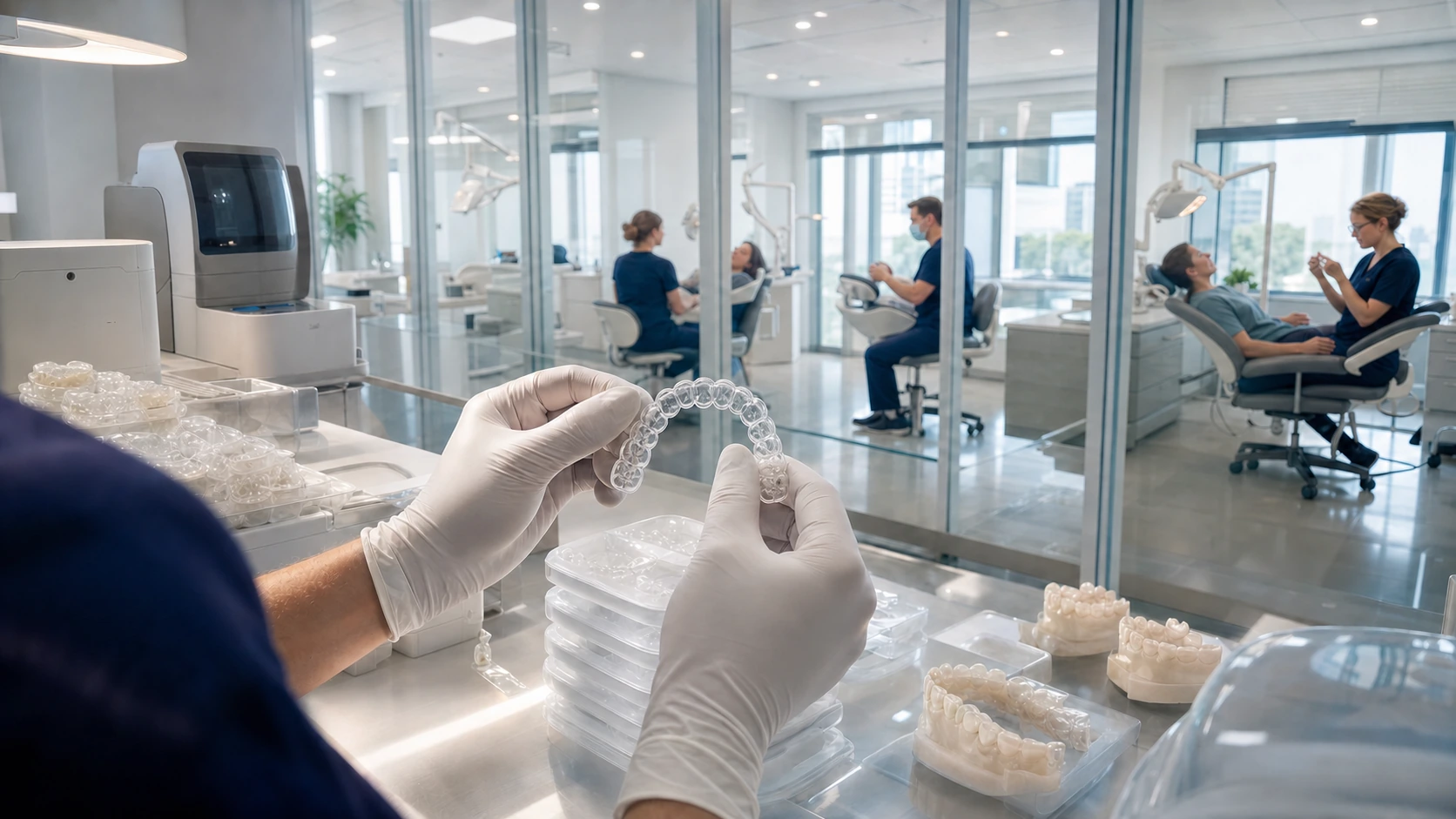
Before signing an agreement, evaluate the complete operating system around the aligners: case intake, treatment-plan approval, manufacturing traceability, location-level reporting, refinements, packaging, delivery and complaint handling. A weakness in any one of these areas becomes more expensive as the number of locations grows.
A solo dental practice can often manage exceptions through direct communication with a laboratory. A group operating five, 20 or 100 locations cannot rely on exceptions. It needs a standardized clear aligner program that clinicians can follow, operations teams can measure and patients can experience consistently.
This guide is written for DSO leaders, clinical directors, procurement teams, orthodontists, group-practice owners, dental laboratories and organizations considering an OEM or white-label clear aligner program.
1. Define the Clear Aligner Program Before Comparing Manufacturers
A productive supplier search begins with an internal decision: what exactly is your organization trying to build?
Some groups want a manufacturer to fabricate aligners from treatment plans approved by their own clinicians. Others need a broader service that includes digital treatment planning, case coordination, technical support and private-label packaging. A multi-location group may also need centralized billing, separate shipping destinations, role-based portal access and consolidated reporting.
Document the intended operating model
- Which clinicians may prescribe and approve treatment?
- Will treatment planning remain in-house or be supported by an external planning team?
- Which intraoral scanners and file formats are used across the group?
- Will cases ship to individual clinics, regional hubs or a central distribution point?
- Will the aligners carry the manufacturer's brand or the dental group's brand?
- What information must operations leaders see at location and group level?
- Which countries or jurisdictions will receive the devices?
This brief prevents a common procurement mistake: choosing a technically capable manufacturer whose workflow does not fit the way the dental group actually operates.
2. Examine the Manufacturing Quality System, Not Only the Finished Aligner
A sample aligner can look clear and fit a model well, but one sample does not demonstrate consistent production. Multi-location practices should examine the controls used across the entire manufacturing process.
Material documentation
Ask the manufacturer to identify the material used for each product and provide the appropriate technical, biocompatibility and traceability documentation. Clarify whether the program uses single-layer or multilayer material, how incoming material is inspected and how lot information is connected to the finished case.
Process validation and quality control
The supplier should be able to explain how it controls model production, thermoforming or direct printing, trimming, finishing, labelling and final inspection. The discussion should include how nonconforming devices are identified, quarantined, investigated and replaced.
Case-level traceability
Each manufactured set should be traceable to the prescription, approved treatment plan, material lot, production record and shipment. Traceability matters when a clinic reports a fit problem, damaged stage, labelling error or unexpected delay.
ISO 13485 is a widely used quality-management standard for organizations involved in medical-device design, production and related services. Certification does not replace product-specific market authorization, but it can provide evidence that the manufacturer operates a structured medical-device quality system. Buyers should confirm the certificate's scope, issuing certification body and current validity.
3. Verify Regulatory Readiness for Every Target Market
Developed markets do not share one universal medical-device pathway. A supplier that can serve one country may not automatically be ready for another. Regulatory status should therefore be checked by device, legal manufacturer, brand, intended use and destination market.
| Market | What buyers should verify | Useful evidence |
|---|---|---|
| United States | Confirm the relevant device's FDA pathway and do not confuse establishment registration with product clearance. | Product code, 510(k) number where applicable, device listing and legal-manufacturer details. |
| European Union / EEA | Confirm conformity with the applicable EU Medical Device Regulation requirements and the basis for CE marking. | Declaration of conformity, certificate where applicable, notified-body details and economic-operator information. |
| Great Britain | Confirm applicable UK requirements, MHRA registration and the role of a UK Responsible Person when the manufacturer is based outside the UK. | Current registration details, responsible-person agreement and conformity documentation. |
| Australia | Confirm the device's regulatory classification, Australian sponsor and inclusion in the Australian Register of Therapeutic Goods where required. | ARTG entry, sponsor details and conformity evidence. |
| Canada | Confirm the applicable Health Canada medical-device licence and establishment-licensing responsibilities for the proposed supply chain. | Licence records, importer/distributor responsibilities and quality-system evidence. |
In the United States, the FDA classifies a sequential aligner under product code NXC as a Class II device with a 510(k) submission type. Importantly, FDA establishment registration or device listing alone does not mean that a device is approved, cleared or authorized. Procurement teams should verify the actual regulatory record rather than accept an “FDA registered” badge as sufficient evidence.
Similarly, MHRA registration is not an endorsement or certification by the UK regulator. It is a registration requirement that should be reviewed alongside the applicable conformity documentation. For a detailed overview, see the Clear Moves guide to clear aligner certifications and market requirements.
4. Test the Cloud-Based Aligner Workflow Across Locations
A scalable aligner program starts with a reliable digital handoff. Every participating clinic should be able to move from patient records to an approved prescription without improvising file names, email threads or approval steps.
Scanner and file compatibility
Confirm compatibility with the intraoral scanners already deployed across the organization. The workflow should specify accepted file formats, scan-quality requirements, bite-registration requirements, required photographs and the process for resolving incomplete records.
Role-based access and approvals
A cloud-based treatment-planning platform should support the organization's governance model. A treating clinician may need to submit and approve a case, while a clinical director needs oversight across several locations and an operations user needs status visibility without access to unnecessary clinical information.
Revision history and communication
Treatment-plan comments, requested changes and approvals should remain attached to the case. This produces a clearer audit trail than fragmented messaging and reduces the risk that production begins from an outdated version.
Security and data responsibilities
Ask where patient information is processed and stored, how access is controlled, how data is encrypted, how long records are retained and how incidents are handled. The contractual allocation of privacy and security responsibilities should reflect the markets in which the group operates.
Clear Moves' doctor portal and case-management guide provides additional context on centralizing submissions, plan reviews and production tracking.
Comparing Manufacturers for a Dental Group?
Clear Moves Aligners works with DSOs, group practices, laboratories and aligner brands on digital treatment planning and OEM or white-label manufacturing.
[email protected]5. Keep Clinical Decisions With Appropriately Licensed Professionals
A manufacturer may provide software, planning technicians, workflow support and draft treatment setups, but the prescribing and approval model must comply with the rules that apply to the treating practice and patient location.
For multi-location practices, clinical governance should define:
- who assesses patient suitability and performs the required examination;
- who prescribes treatment and approves the final digital setup;
- which cases require specialist review or referral;
- how interproximal reduction, attachments and other clinical procedures are authorized;
- the schedule and method for in-person or remote progress reviews;
- the escalation pathway for tracking problems, pain, periodontal concerns or unexpected movement; and
- how refinements, retention and long-term follow-up are managed.
Remote monitoring should strengthen care—not remove accountability
Remote progress monitoring can help a dental group maintain consistent check-ins and identify cases that need attention between visits. It should not be positioned as a substitute for appropriate diagnosis, clinician oversight or an in-person assessment when clinically indicated.
Ask a prospective manufacturer how its platform records patient submissions, clinician reviews, alerts, instructions and escalations. The strongest workflow makes accountability visible at every stage.
6. Measure Whether the Manufacturer Can Scale Without Losing Control
Production capacity is only one part of scalability. A supplier can have enough machines and still struggle with case communication, quality investigations, shipping accuracy or account support.
Capacity and service levels
Request written definitions for treatment-planning turnaround, production turnaround, urgent replacements, refinement processing and support response times. Clarify when the clock starts, which events pause it and how performance is reported.
Multi-address fulfilment
Test whether the manufacturer can reliably route cases to different locations, separate invoices by clinic or cost centre, provide group-level statements and prevent one clinic's patient materials from being shipped to another.
Business continuity
Discuss backup equipment, power and network resilience, qualified alternate material sources, disaster recovery, staff coverage and the process for communicating an interruption. The goal is not a promise that delays can never occur; it is evidence that foreseeable disruptions are planned for and managed.
Location-level reporting
Useful reporting may include submitted cases, approved cases, time awaiting clinician action, production status, refinements, remakes and turnaround performance. These metrics help clinical leaders identify training needs and help operations teams distinguish a local bottleneck from a supplier bottleneck.
7. Compare Total Program Value, Not Just the Per-Case Quote
A low headline price can become expensive once planning fees, refinements, retainers, replacement stages, shipping, portal access, branding and support are added. Compare proposals using a common scenario and request a complete schedule of inclusions and exclusions.
| Cost area | Questions to clarify |
|---|---|
| Treatment planning | Is planning included? How many plan revisions are covered? Who approves production? |
| Manufacturing | What is included in each case tier? Are both arches, attachments templates or passive aligners included? |
| Refinements and remakes | What qualifies for a refinement or remake, and what documentation is required? |
| Retention | Are retainers included, optional or billed separately? What replacement program is available? |
| Technology | Are portal access, integrations, storage, reporting or additional users charged separately? |
| Branding and fulfilment | What are the setup fees, minimum quantities and recurring costs for branded packaging and multi-location shipping? |
| Support and training | Which onboarding, clinical education and account-management services are included? |
The correct comparison is the expected cost of running the program at scale, not the cost of producing one uncomplicated case.
8. Run a Controlled Pilot Before a Network-Wide Rollout
A pilot gives both parties a chance to test the workflow under real operating conditions before committing the entire group. Select a small group of locations that represents the network: different scanners, clinician experience levels, case volumes and shipping destinations.
Suggested pilot scorecard
- percentage of submissions accepted without missing records;
- time from complete submission to first treatment setup;
- number and type of requested setup revisions;
- time from clinician approval to dispatch;
- shipping and labelling accuracy;
- frequency and cause of remakes or replacements;
- support response and resolution time;
- clinician satisfaction with the portal and plan-review process; and
- patient-facing fit, packaging and instruction feedback.
Agree on success criteria before the pilot starts. After completion, document the standard operating procedure, training materials, escalation contacts and reporting cadence needed for wider deployment.
9. Questions to Ask Every Clear Aligner Manufacturer
- Which legal entity manufactures the aligners, and where does production occur?
- Which device registrations, clearances or conformity documents apply to each target market?
- What is the scope and current status of your ISO 13485 certification?
- How are materials, production records and finished cases traced?
- Which intraoral scanners and file formats can each location submit?
- How are treatment-plan changes recorded and approved before manufacturing?
- What are the responsibilities of planning technicians, clinicians and specialist reviewers?
- How does the system support clinician-supervised remote monitoring and escalation?
- What service levels are documented for planning, production, refinements and replacements?
- Can invoices, reports, branding and shipments be separated by location?
- How are complaints, adverse events, nonconforming products and recalls handled?
- What happens to case data and active patients if the agreement ends?
Evaluating a multi-location clear aligner program?
Clear Moves Aligners provides digital treatment planning and OEM or white-label manufacturing support for dental practices, DSOs, laboratories and aligner brands. Discuss your target markets, expected volume, scanner workflow, branding and fulfilment requirements with our team.
[email protected]Frequently Asked Questions
What is the best clear aligner manufacturer for a multi-location dental practice?
What is a white-label clear aligner program?
Can one clear aligner workflow support different intraoral scanners?
Does FDA registration mean a clear aligner is FDA cleared?
Can remote monitoring replace in-person clear aligner appointments?
How should a DSO compare clear aligner manufacturing prices?
Worldwide

Sources and Further Reading
- US FDA: sequential aligner product classification (NXC)
- US FDA: registration and listing do not denote device approval or clearance
- ISO: ISO 13485 quality management systems for medical devices
- European Commission: medical-device regulations
- MHRA: registering medical devices for the UK market
- MHRA Public Access Registration Database
- TGA: medical-device inclusion process in Australia
- Health Canada: medical-device regulation and licensing resources