Why Minimum Orders Work Differently for Aligners
If you are planning your own clear aligner brand, the first supplier question is usually the same: how many cases do I have to commit to? It is a fair question. A dental lab, a single practice or a new aligner company rarely wants to sign for hundreds of cases before it knows how patients will respond to the brand.
The answer is different from most private label products. Clear aligners are made for one patient at a time, from that patient's scans and approved treatment plan, so there is no warehouse of finished stock to clear. In a well-run white label program, the minimum rarely sits on the aligners themselves. It sits in the contract around them: case commitments, packaging print runs, setup work, pricing tiers and exclusivity.
This guide is for dentists, orthodontists, clinic groups, dental labs and new aligner brands comparing white label, private label or OEM suppliers. It explains where minimums usually sit, how a low-volume start works, what exclusivity tends to cost, and which labeling rules decide who carries manufacturer obligations once your brand goes on the box.
- Look past the per-case price. Because aligners are patient-specific, most minimums sit in packaging runs, monthly commitments, setup fees and exclusivity terms rather than in aligner units.
- Get every minimum in writing. Ask for case commitments, packaging quantities, setup fees and pricing-tier rules in the quote itself.
- Brand in stages. Start with neutral or semi-custom packaging and branded labels, then order fully printed packaging once your volume is proven.
- Exclusivity costs volume. Define the territory, channel, term and performance targets before you agree to them.
- The label decides responsibility. Whose name appears on the device changes your obligations, and the rules differ between the US and the EU.
Where Minimums Actually Sit
When a supplier says it has no minimum order, check which minimum it means. A white label aligner program can set a floor at several points, and each one affects your cash flow differently.
| Minimum | What it covers | Why suppliers set it | What to ask |
|---|---|---|---|
| Case commitment | A set number of cases per month, quarter or year | Capacity planning and guaranteed pricing | Is it a target or a take-or-pay obligation, and what happens if you miss it? |
| Branded packaging run | Printed boxes, aligner cases, pouches and inserts with your logo | Printing is set up and paid for per run | What is the smallest run for each item, and can you start on neutral stock? |
| Setup fee | Artwork, label templates, portal branding and onboarding | Fixed work done once per brand | Is it one-off, credited against early cases or waived? |
| Pricing-tier threshold | The volume needed to reach a lower per-case price | Larger volumes lower unit costs | How is volume counted, and how often is your tier reviewed? |
| Exclusivity commitment | The volume needed to keep a territory or channel to yourself | Protects the supplier's other markets | Do you lose exclusivity only, or can the whole agreement end, if you fall short? |
| Branded stock items | Retainers, aligner cases, chewies and cleaning products under your brand | Standard items are produced in batches | Which items have their own minimums and reorder lead times? |
Most of these are commercial terms rather than production limits. That means they can usually be negotiated, staged or waived, as long as you raise them before you sign.
How a Low-Volume Start Works
A low-minimum program bills each case as it is ordered. You submit the scans, approve the 3D setup and pay for that patient's aligners, with no stock to buy in advance. Volume-based pricing then lowers the per-case price as your monthly cases grow, instead of asking you to commit to that volume up front.
Branding can grow the same way. Most new brands do not need fully printed packaging on day one, and a staged approach keeps early costs low while you test demand:
- Run a pilot.Send a small number of cases to test fit, planning turnaround, communication and patient feedback before you invest in branding. Our manufacturing pilot checklist sets out what to measure.
- Add brand basics.Use neutral packaging with your logo on labels or inserts, a branded doctor portal and your own patient instructions.
- Order printed packaging.Commit to a full packaging run once your monthly case volume means you will use the print quantity within a reasonable time.
- Negotiate with real data.Use your actual case volume, refinement rate and reorder pattern, not projections, to negotiate pricing tiers or exclusivity.
This sequence matters most for single practices and labs, where cash tied up in packaging can outweigh the margin on the first months of cases.
What a Per-Case Price Should Include
Two suppliers can quote the same per-case price and deliver very different value. Before you compare pricing tiers, make sure each quote covers the same work:
- Aligner stages. Whether the price is per case, per arch or per stage, and how limited and comprehensive cases differ.
- Treatment planning. How many setup revisions are included before approval.
- Refinements. How many refinement series are covered, and for how long.
- Retainers. Whether a retainer set is included at the end of treatment.
- Packaging and labeling. Whether branded packaging is part of the case price or billed separately.
- Shipping and duties. Who pays for delivery, and whether international orders arrive with duties already paid.
Then check how the tier itself works. Is volume counted per calendar month or as a rolling average? Is your tier reviewed monthly, quarterly or yearly? Does one slow month move you to a higher price, or only a sustained drop? Our OEM request for quote template helps you ask every supplier for the same pricing units, so you can compare quotes line by line.
Packaging: The Minimum Most Brands Meet First
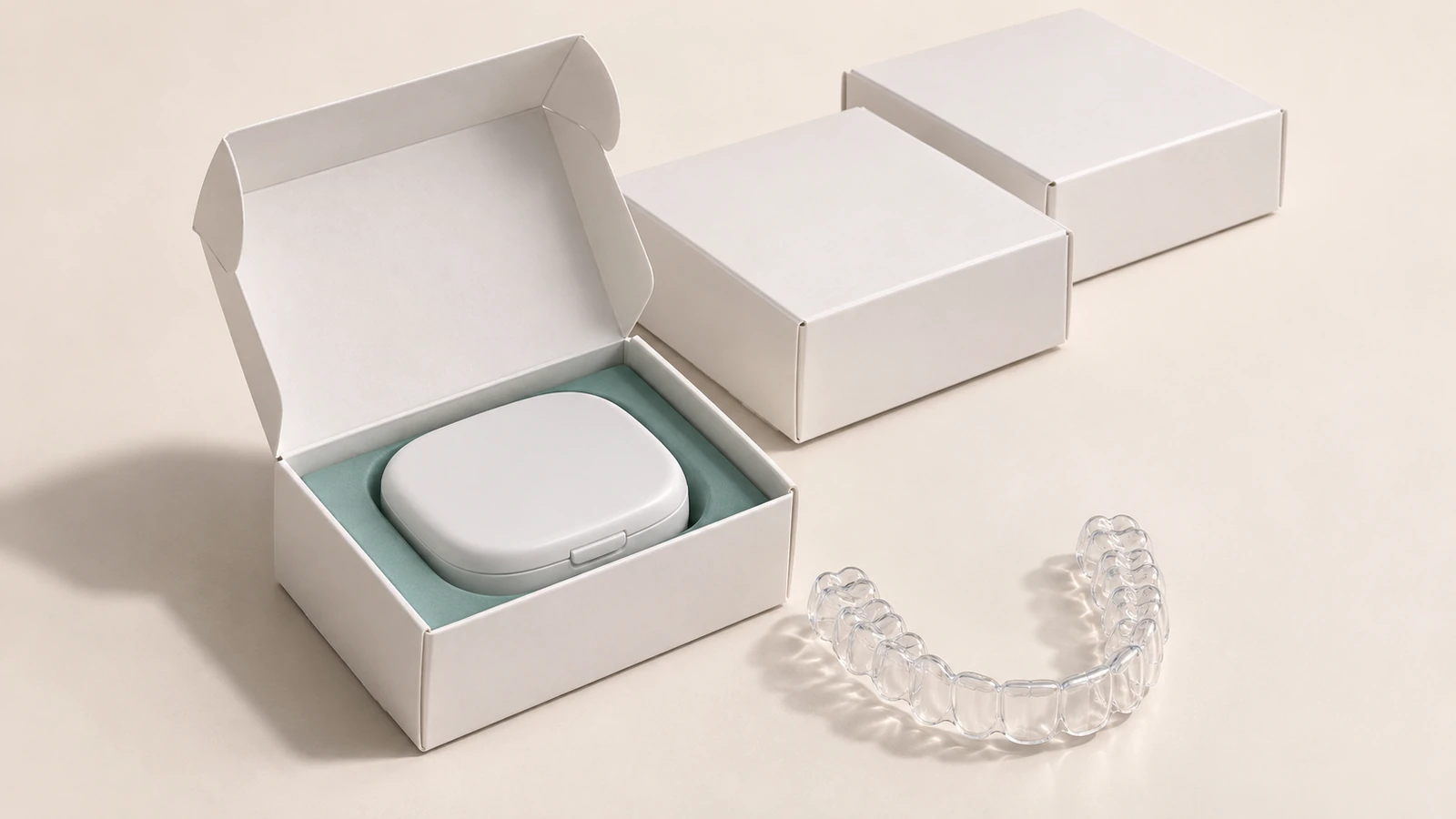
For most new aligner brands, packaging is where the first real minimum appears. Printed boxes, aligner cases, pouches and inserts are produced in runs, and each run carries fixed setup work, so the smallest economical quantity can be more than a new brand needs in its first months.
There are three ways to keep packaging from becoming a barrier:
- Neutral packaging with branded labels. The lowest upfront cost, and quick to change if your branding evolves.
- Semi-custom packaging. Stock boxes or cases with printed sleeves, stickers or inserts carrying your logo and colors.
- Fully custom packaging. Your own printed boxes, cases, bags and welcome kits, ordered once volume supports the run.
Whichever route you choose, treat packaging artwork like a regulated label, because it often is one. Approve proofs for stage identification, patient details, instructions and required regulatory information before anything is printed. Our packaging proof checklist covers what to review.
Exclusivity and Distributor Branding
Exclusivity is usually where low minimums end. A supplier that agrees not to serve your competitors in a territory gives up business, so it will normally ask for a volume commitment in return. That trade can be worth making, but only if the terms are specific:
| Term | What to define |
|---|---|
| Territory | The exact countries, states or regions covered |
| Channel | Whether exclusivity covers clinics, labs, direct-to-patient sales or all of them |
| Scope | Whether it protects your brand only, or stops the supplier serving similar brands in your territory |
| Term and renewal | How long exclusivity lasts and how it is renewed |
| Performance targets | The volume you must reach, how it is measured and any grace period |
| Consequence of a miss | Whether you lose exclusivity only, or the supplier can end the whole agreement |
Distributors that sell a branded aligner line to clinics should also settle who owns the brand. Register the brand name as a trademark in your own company's name in each market you sell in, and keep the artwork files. As the USPTO explains, a trademark is what protects a brand name and logo; registering a domain name gives you no trademark rights.
Whose Name Goes on the Label
Putting your brand on aligners does not automatically make you the manufacturer, but it can, depending on the market and how the label is written. Settle this with your supplier and a regulatory advisor before your first branded case ships.
United States. Sequential aligners are Class II devices that need FDA 510(k) clearance under product code NXC. According to the FDA's 510(k) FAQ, a company that distributes another manufacturer's device under its own name does not submit its own 510(k); the manufacturer does, if one is required. The label must show the relationship: under 21 CFR 801.1(c), a name that is not the manufacturer's must be qualified with wording such as “Manufactured for” or “Distributed by”. If you change the device or its labeling beyond adding your name, or market it for a different use, you may need your own clearance.
European Union. Under Article 16 of the EU MDR, a distributor, importer or other person that makes a device available under its own name or registered trademark takes on the obligations of a manufacturer. The exception is a distributor or importer with an agreement under which the manufacturer is identified as such on the label and stays responsible for the manufacturer's requirements. The Medical Device Coordination Group's guidance documents include a Q&A on repackaging and relabeling under Article 16 (MDCG 2021-26).
UK, Australia and other markets. Each market has its own registration and responsible-person rules. Our clear aligner certifications guide explains FDA 510(k), ISO 13485, CE, EU MDR, MHRA and TGA, and how to verify a manufacturer's status before you sign.
Questions to Ask Before You Sign
Send the same questions to every supplier on your shortlist, and ask for the answers in writing:
- Is there a minimum number of cases per month, quarter or year? If so, is it a target or a binding commitment?
- What are the packaging minimums? The smallest run for each item, the reorder lead time and whether you can start on neutral stock.
- Are there setup, artwork or portal fees? Whether they are one-off, credited or waived.
- What does one case include? Stages, setup revisions, refinements, retainers, packaging and shipping.
- How do pricing tiers work? How volume is counted and how often your tier is reviewed.
- What are the exclusivity terms, if any? Territory, channel, term, targets and the consequence of missing them.
- Who owns what? Your trademark, artwork, patient records, scans, STL files and approved treatment plans, and how you get them back if you leave.
- Which documents prove compliance? The 510(k) number, ISO 13485 certificate, CE certificate and declaration of conformity, and MHRA or TGA registration, as relevant to your markets.
- How do deliveries work? Lead times, tracking, shipping to several locations and duties on international orders.
Our comparison of white label vs private label vs OEM clear aligners explains how each model changes these answers, especially around design control and documentation.
Plan your first branded cases
Share your expected monthly volume and packaging ideas, and our team will outline a white label program around them, with no minimum order.
[email protected]Common Minimum Order Mistakes
- Comparing per-case prices without checking what each case includes.
- Ordering a large packaging run before patient demand is proven.
- Accepting exclusivity with vague territory or performance terms.
- Signing a take-or-pay commitment based on optimistic projections.
- Leaving label wording to the printer instead of agreeing it with the manufacturer.
- Not registering the brand as a trademark in your own company's name.
- Ignoring exit terms, including access to your case data and files.
How Clear Moves Aligners Supports Low-Volume Brands
Clear Moves Aligners is a clear aligner manufacturer and treatment planning partner for clinics, dental labs, DSOs and aligner brands, and we have no minimum order volume. We work with solo practices processing a few cases a month through to aligner companies handling thousands, with volume-based pricing that scales as your cases grow. We offer white label, private label and OEM programs, and our OEM and white label manufacturing includes custom-branded packaging, from boxes and bags to inserts and welcome kits, plus a branded doctor portal.
Initial 3D treatment plans are typically delivered within 24 to 48 hours of receiving approved digital scans, and we revise them until you approve the setup. Our aligners are FDA 510(k)-cleared (K241137, product code NXC), and we are ISO 13485 certified, CE-marked under the EU MDR, MHRA-registered and TGA-listed, with express delivery to more than 30 countries. To see how a branded program is set up, visit our white label clear aligners page or talk to our team about your expected volume.
Frequently Asked Questions
Do white label clear aligner manufacturers have minimum order quantities?
Can a single dental practice launch its own aligner brand?
What is the minimum order for custom aligner packaging?
Does exclusivity require a minimum volume?
Do I need my own FDA 510(k) to sell aligners under my brand?
Who is the manufacturer when aligners carry my brand in the EU?
Worldwide