
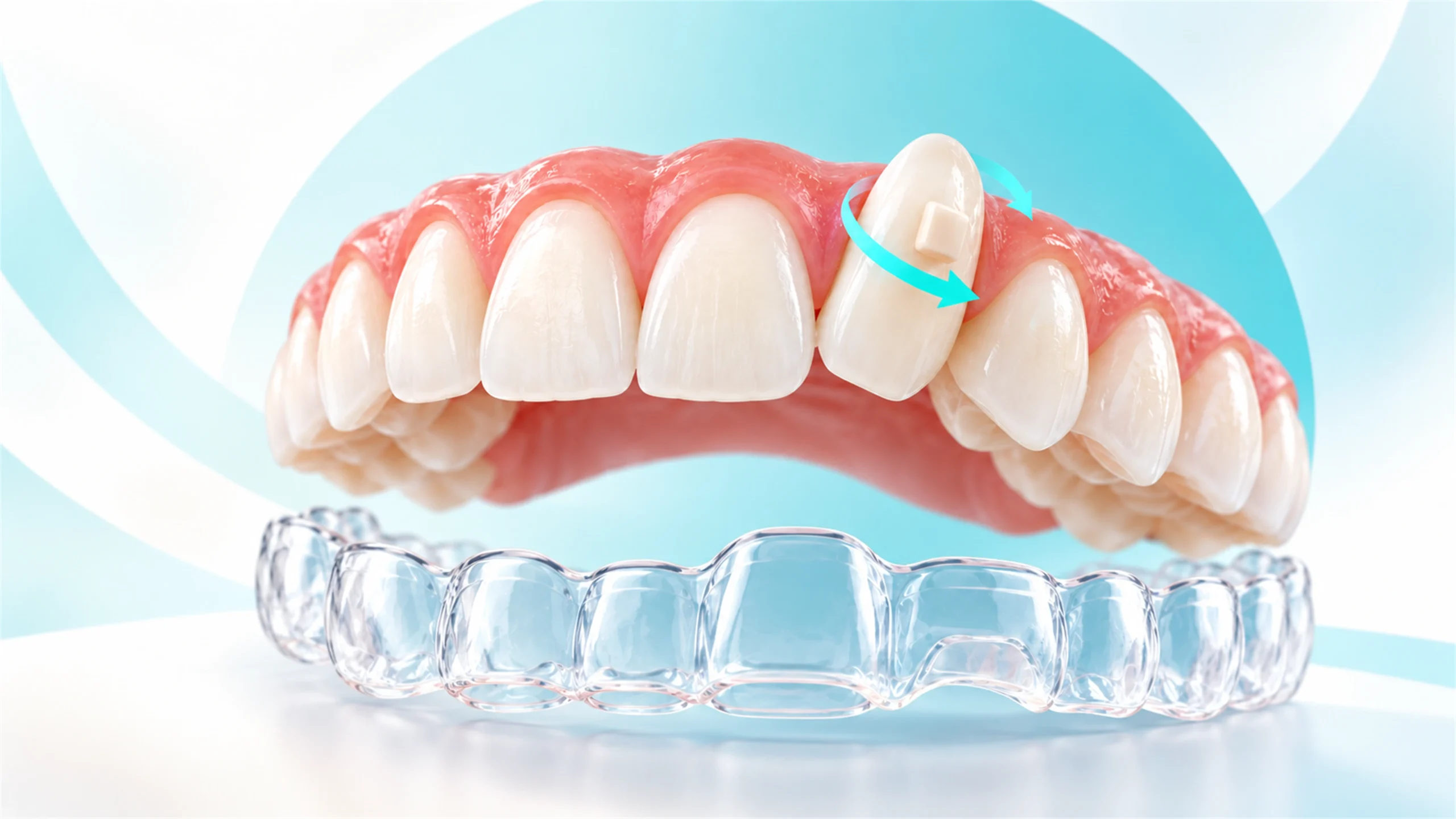
Why Rotations Need a Specific Plan
Rotations look simple on a digital setup. The software turns the tooth around its long axis, the aligner stages the movement, and the final position looks ideal. In practice, rotations are among the movements clear aligners deliver least accurately, especially on rounded teeth such as canines and premolars.
For dentists, orthodontists and group practices running aligner cases, unplanned rotation shortfalls are a common reason for refinements, extra appointments and longer treatment. For labs and aligner brands, they show up as tracking complaints and remake requests. Most of these problems are predictable, and many can be reduced at the planning stage.
This guide summarizes what clinical and in vitro studies report about derotation with aligners, why rounded teeth are harder to control, and the planning levers available: staging, attachments, space, overcorrection and auxiliaries.
- Rotation accuracy is limited. Clinical studies report mean accuracy of roughly 36% to 46% for rotations, below many other movements.
- Canines and premolars are hardest. Their rounded crowns give the aligner little surface to grip.
- Large rotations lose more. In one study, premolar derotation accuracy fell from 43.3% to 23.6% when predicted rotation exceeded 15°.
- Staging matters. The same study found 41.8% efficacy below 1.5° per aligner and 23.2% above it.
- Plan for the shortfall. Space, attachments, slower staging, overcorrection and auxiliaries all help, and refinements should be expected in severe rotations.
What the Evidence Shows on Rotation Accuracy
Most clinical data come from studies that compare the predicted final position in the setup with the achieved position on a post-treatment scan. The studies below all used one widely used aligner system, so results may not transfer exactly to other systems or materials, but the pattern is consistent.
Scroll horizontally to see the full table →
| Study | Design | Rotation finding |
|---|---|---|
| Kravitz et al., 2008 | Prospective, 53 canines in 31 adults | Mean canine rotation accuracy 35.8%; only 15 of 53 canines exceeded 50% |
| Kravitz et al., 2009 | Prospective clinical study | Mandibular canine rotation was among the least accurate movements; accuracy dropped for rotations over 15° |
| Simon et al., 2014 | Retrospective, 20 premolar derotations | Mean accuracy 37.5% with attachments and 42.4% without; 23.6% when predicted rotation exceeded 15° |
| Haouili et al., 2020 | Prospective, 38 patients, 899 teeth | Overall accuracy 50%; rotation 46%, the lowest category; maxillary canine distal rotation 37% |
The 2008 canine study was published in the Angle Orthodontist, the 2009 and 2020 studies in the American Journal of Orthodontics and Dentofacial Orthopedics (2020 follow-up), and the premolar study in BMC Oral Health.
Why Rotations Are Hard for Aligners
Crown shape and grip
An aligner moves a tooth by pushing on its surfaces. Incisors have broad, relatively flat labial and lingual faces that give the plastic a lever. Canines and premolars are rounder in cross-section, so as the aligner tries to turn them, it tends to slip around the crown instead of gripping it. Rounded crowns can also produce an intrusive side effect as the plastic slides over the convexity.
Contacts and crowding
A tooth that is tight against its neighbors cannot turn freely. If space is not created before or during the rotation, the contacts resist the movement and the aligner may lose fit.
Aligner deformation and fit
Each aligner can only apply force while it is seated and engaged. Large per-stage rotations increase the mismatch between the aligner and the tooth, which can reduce engagement and lead to tracking problems. Our article on tooth movement biomechanics in clear aligner treatment explains these force systems in more detail.
Staging: How Much Rotation per Aligner?
Simon et al. compared premolar derotation by staging speed. With less than 1.5° per aligner, total efficacy was 41.8%. With more than 1.5° per aligner, it fell to 23.2%. Accuracy was also significantly reduced for predicted rotations greater than 15°.
An in vitro study in Frontiers in Bioengineering and Biotechnology (2022) that measured forces on a rotated premolar recommended steps of about 1–1.5° per aligner, noting that moments were already high above 1°.
- Keep per-stage rotation small on rounded teeth.Around 1–1.5° per aligner is a reasonable starting point for canines and premolars, based on the studies above.
- Expect more aligners for large rotations.A 30° premolar rotation at 1.5° per stage needs about 20 aligners for that movement alone.
- Avoid stacking difficult movements.Combining large rotation with extrusion or root movement on the same tooth at the same time makes tracking harder.
- Check wear schedules.Slower staging works only if each aligner is worn long enough to express the movement.
Attachments for Derotation
Attachments give the aligner a surface to push against. The clinical evidence on whether they improve rotation accuracy is mixed, while in vitro work shows they change the force system substantially.
- Clinical studies: Kravitz et al. (2008) found canines with attachments alone reached 33.3% accuracy versus 30.8% with no adjunct, a difference that was not statistically significant. Simon et al. (2014) found premolar derotation accuracy was not higher with attachments.
- In vitro data: Ferlias et al. (2022) measured derotation moments on an upper second premolar. Without an attachment, the moment at 4.5° of mesial rotation was about 2,198 cNmm. With vertical rectangular attachments it rose to about 6,761–7,640 cNmm, but these designs also produced the largest unwanted forces and moments.
The practical reading is that attachments can increase the rotational moment on a rounded tooth, but they do not remove the need for slow staging, space and overcorrection. Attachment shape and placement also create side effects that need to be considered in the plan. For more on design and timing, see our guide to attachments, IPR and staging.
Planning a case with large rotations?
Our treatment planning team can stage rotations, attachments and IPR for your next case.
[email protected]Creating Space Before Rotating
In Kravitz et al. (2008), canines that received interproximal reduction (IPR) alone had the highest mean rotation accuracy at 43.1%, with the lowest variability, although the difference from the other groups was not statistically significant. The authors suggested that interproximal contacts may matter.
That fits basic mechanics: a rotated tooth occupies a different amount of arch length than an aligned one, and tight contacts resist the movement. In the setup, consider:
- Sequencing: resolve crowding and open contacts before the bulk of the rotation, rather than rotating into a tight space.
- IPR timing: schedule IPR at the stage where the rotation begins, not after the tooth has already been pushed against its neighbors.
- Delivered amounts: record what was actually removed at each contact so that refinements are planned from real data.
Overcorrection and Refinements
Because rotations are often under-expressed, many planners add overcorrection to rotated teeth so that the expected shortfall still leaves the tooth close to the target. There is no single evidence-based amount, and the right figure depends on tooth type, rotation size and the aligner system. Overcorrection should be shown clearly in the setup and agreed by the clinician, not added silently.
Even with good planning, severe rotations on rounded teeth often need a refinement. Telling the patient at consultation that a refinement phase is likely, and pricing the case with that in mind, avoids surprises for the practice. Our guide on how to reduce clear aligner refinements covers other common causes.
When to Add Auxiliaries
Some rotations are better handled with help. Options used alongside aligners include bonded buttons with elastics to create a couple on the tooth, short phases of sectional fixed appliances, or a pre-aligner phase to correct a severe rotation before the main aligner series. Case selection matters here: a premolar rotated well beyond 15–20°, or a rotation combined with significant extrusion, is a reason to discuss an auxiliary plan before the case is approved.
Case selection checklist
- Rotation size on each tooth, with canines and premolars flagged separately.
- Available space and planned IPR at the rotated tooth.
- Crown shape and height, including short clinical crowns.
- Combined movements on the same tooth, such as extrusion or torque.
- Whether the clinician is willing to use buttons, elastics or sectional appliances if needed.
Retention After Derotation
Rotated teeth are widely regarded as prone to relapse, so the retention plan should be part of the treatment plan, not an afterthought. For teeth with large initial rotations, consider the retainer type, wear schedule and whether bonded retention is appropriate. Our article on the clear aligner retention protocol sets out a practical approach.
Limits of the Evidence
The clinical studies cited here have modest sample sizes, were carried out in specific centers and used one aligner system, some with older materials. Accuracy depends on how it is measured and on compliance. The in vitro attachment data come from a single tooth model and do not include the biological response. These studies are best used to set realistic expectations and to decide which variables to control, not to predict exact outcomes for a given case.
How Clear Moves Aligners Supports Rotation Planning
Clear Moves Aligners is a clear aligner manufacturer and treatment planning partner for dentists, orthodontists, group practices, dental labs and aligner brands. Our planning team stages rotations with tooth type and rotation size in mind, places attachments where they add control, sequences space creation and shows any overcorrection in the setup so you can review it before approval.
If you want an outside team to plan or review your cases, our aligner treatment planning service works alongside your clinicians, and you keep final approval.
Have a case with difficult rotations? Talk to our team about case review, treatment planning support or a white label partnership.
Frequently Asked Questions
How accurate are clear aligners for rotations?
Which teeth are hardest to derotate with aligners?
How many degrees of rotation per aligner should I plan?
Do attachments improve rotation with clear aligners?
Does IPR help with derotation?
When should I add buttons, elastics or sectional appliances?
Should I overcorrect rotations in the setup?
Worldwide