What Is Remote Monitoring in Clear Aligner Treatment?
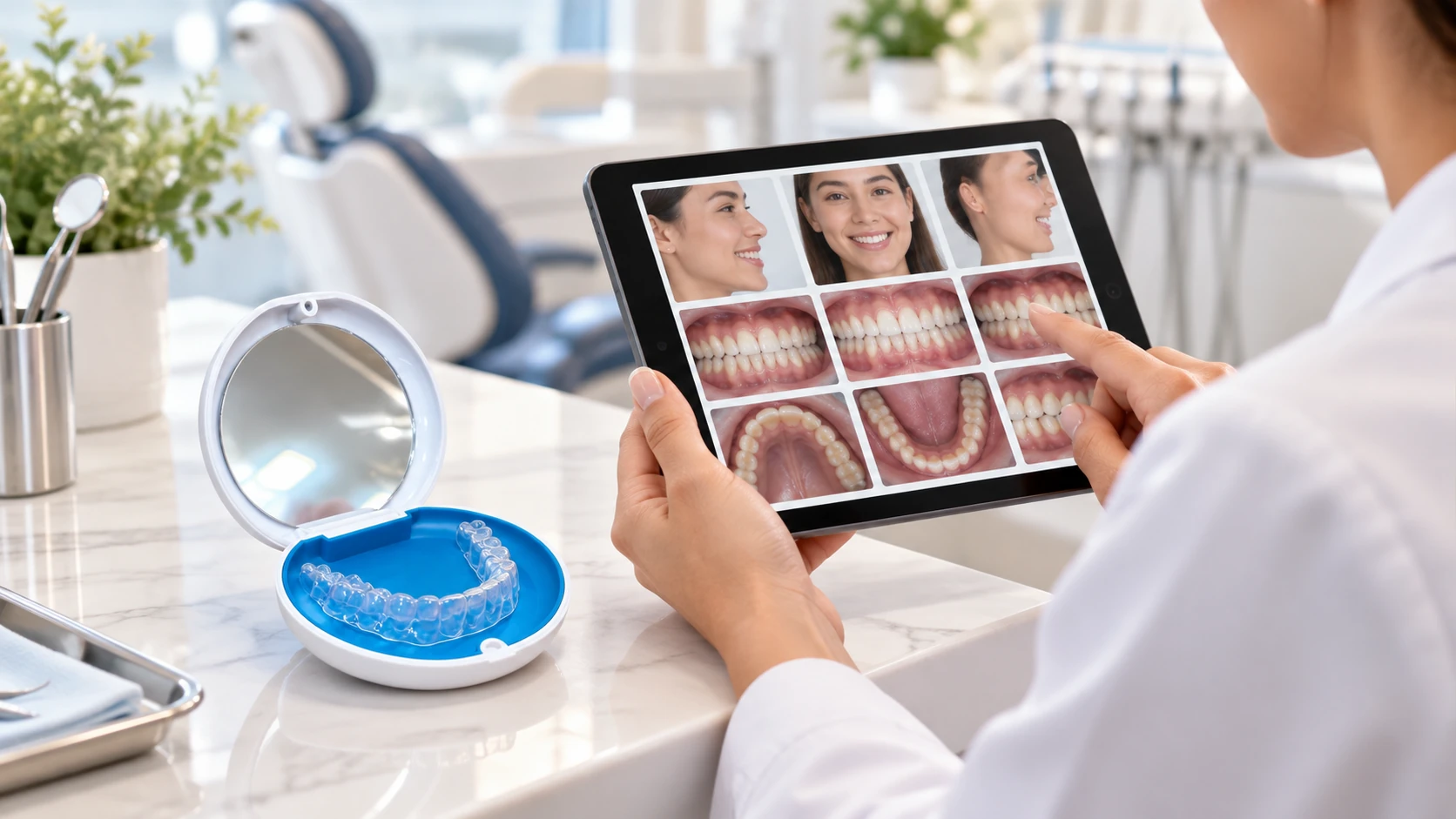
Remote monitoring is the review of a patient's aligner progress between office visits, using intraoral photos or video the patient captures on a smartphone, usually with a cheek retractor. The images are sent through a secure application, software may pre-screen them, and the treating clinician decides whether the patient moves to the next aligner, holds, or comes in.
The ADA policy on teledentistry describes the modalities involved: asynchronous "store and forward" transmission of recorded health information to a practitioner, and remote patient monitoring, in which health data is collected from an individual in one location through electronic communication technologies.
This guide is written for orthodontists, general dentists, group practices and DSOs deciding whether to add remote monitoring to an aligner workflow. It covers what peer-reviewed studies show, where the software is reliable and where it is not, and how to set up a protocol that keeps the clinician in control. It concerns monitoring within supervised treatment, after an in-person examination, not treatment delivered without one.
- Fewer visits is the consistent finding. Controlled studies report between 1.5 and 3.5 fewer in-office appointments per monitored aligner case.
- Shorter treatment is not established. Pooled data show no effect on total treatment time or number of refinements, and one randomized trial found monitored treatment ran 1.9 months longer.
- Problems surface earlier. Monitored patients reached their first refinement sooner, which suggests tracking issues are picked up earlier.
- AI notifications need clinician review. Software detects obvious events well, but is less reliable at locating subtle tracking problems on specific teeth.
- The dentist stays responsible. Professional guidance expects an in-person examination before treatment and regular in-person assessment during it.
How a Remote Monitoring Workflow Runs
Systems differ in detail, but the workflow has four stages.
- Capture. The patient takes a set of intraoral images at an interval the clinician sets, with and without aligners in place.
- Transmission. Images are uploaded through an application to the practice's monitoring dashboard.
- Triage. Software, staff or both screen each submission for aligner fit, lost attachments, damage and visible hygiene problems.
- Decision. The clinician confirms the instruction: proceed to the next aligner, stay in the current one longer, or attend the practice.
The change from a conventional schedule is that review is triggered by data instead of the calendar. A patient who is tracking well is not brought in only to be told to continue. A patient who is not tracking is identified before several more aligners have been worn.
Swipe to compare all columns →
| Factor | Conventional review | Remote-monitored review |
|---|---|---|
| Trigger for review | Fixed appointment interval | Each patient image submission |
| Information available | Full clinical examination | Two-dimensional photos or video |
| Aligner fit and attachments | Checked at each visit | Checked at each submission |
| Probing, occlusion, radiographs | Available | Not available |
| Depends on | Patient attending | Patient capturing usable images |
| Chair time | Used for every review | Reserved for procedures and flagged cases |
What the Evidence Shows on Appointments, Duration and Refinements
The research base is small, and most of it studies a single commercial platform used with one aligner system. With that limit stated, three sources carry most of the weight.
Systematic review and meta-analysis
A 2023 systematic review in the Dental Press Journal of Orthodontics included four non-randomized controlled trials, two of them in clear aligner treatment. Pooling the aligner studies, monitored patients had 2.75 fewer face-to-face appointments (95% CI 1.55 to 3.95) and started their first refinement earlier. Monitoring had no significant effect on total treatment time, the number of refinements or the number of refinement aligners.
The reviewers rated the certainty of the evidence as very low and found no randomized trials at the time. One included study lost 33.3% of an initial sample of 30 participants because they could not use the software properly or follow the scanning protocol.
Retrospective cohort study
One of the pooled studies, published in the American Journal of Orthodontics and Dentofacial Orthopedics, compared 45 monitored and 45 conventionally reviewed aligner patients. The monitored group had 3.5 fewer appointments, a 33.1% reduction, and reached the first refinement 1.7 months sooner. A few tooth movements were statistically more accurate in the monitored group, but none of the differences crossed the study's thresholds for clinical significance of 0.5 mm or 2 degrees.
Randomized controlled trial
A single-center randomized trial, also in the American Journal of Orthodontics and Dentofacial Orthopedics, allocated 56 aligner patients equally to monitored and conventional review. The monitored group had 1.5 fewer clinical appointments. Treatment took 1.9 months longer in the monitored group, and there were no significant differences in the number of refinements or total aligners. Both groups reported similarly high satisfaction.
How Reliable Are AI-Generated Notifications?
Many platforms use image-analysis software to issue a proceed or hold instruction and to flag clinical events. Two studies have tested that output directly.
- Repeatability. A prospective study in the American Journal of Orthodontics and Dentofacial Orthopedics had 30 patients scan twice in succession. The overall instruction agreed between the two scans for 83.3% of patients. None of the paired scans agreed completely on which teeth, or how many, had tracking issues. The authors reported concerns with the consistency of remote monitoring instructions.
- Detection accuracy. A 2026 study in Orthodontics & Craniofacial Research compared AI notifications for 23 aligner patients with an orthodontist's visual review of the same scans. At the level of the whole scan, accuracy was 100% for button loss, 99.3% for aligner damage, 98.5% for attachment loss, 93.1% for a noticeable unseat and 80.7% for a slight unseat. When the software had to name the affected tooth, accuracy for a slight unseat fell to 54.2%. Sensitivity for oral hygiene findings ranged from 5.6% to 75%.
The second study concluded that the monitoring "is not fully automated and must be closely followed by the overseeing orthodontist." A 2025 scoping review of nine studies in Medicina reached the same position: "AI should be used as a complementary tool, never a substitute, for clinical judgment." That review also noted that current applications are largely confined to a single commercial platform, with gaps in independent validation.
In practice, treat a notification as a prompt to look. Software is dependable for events that are visually obvious, such as a missing attachment. It is less dependable for the early, small fit discrepancies that matter most for catching a tooth that has stopped tracking.
What Remote Monitoring Can and Cannot Assess
A photo-based review answers a narrower set of questions than a clinical examination. The 2026 detection study lists the reasons: two-dimensional images cannot capture the full three-dimensional context of tooth movement, and smartphone camera quality, lighting and imaging angle all affect the result.
Suited to remote review
- Aligner seating and visible gaps between aligner and tooth
- Lost or damaged attachments and buttons
- Cracked or distorted aligners
- Visible plaque, gingival inflammation and soft tissue irritation
- Whether the patient is on the expected aligner number
Requires an in-person visit
- Periodontal probing, mobility and bleeding on probing
- Occlusal contacts and functional assessment
- Root position and anything that needs a radiograph
- Bonding or rebonding attachments, interproximal reduction and auxiliaries
- New intraoral scans for a refinement
Gingival assessment is a clear example. The same study notes that its gingivitis findings rested on visual indicators only, without probing depth, bleeding on probing or attachment level measurements.
Building a monitored aligner workflow?
Talk to our team about treatment planning, refinement turnaround and case management for your practice or group.
[email protected]Professional Standards, Privacy and Documentation
Remote monitoring is teledentistry, and the standards for teledentistry apply to it. Requirements vary by state and country, so confirm the rules with your dental board and legal adviser. The points below are general information, not legal advice.
- Responsibility and licensure. Under the ADA policy, the dentist remains responsible for the safety and quality of care, and must be licensed in the state where the patient receives services. The policy also sets out patient protections, including informed consent, proper documentation and compliance with privacy and security requirements.
- In-person examination. The American Association of Orthodontists' teledentistry parameters state that treatment should not begin before a physical, in-person examination by a state-licensed dentist. They also call for regular in-person assessment during active treatment, and for patients to have access to in-person visits on request.
- Privacy and security. Patient images are protected health information. The U.S. Department of Health and Human Services publishes HIPAA and telehealth guidance for covered providers. Its guidance on remote communication technologies explains that a vendor that creates, receives or maintains protected health information needs a business associate agreement in place.
- Documentation and coding. The ADA's guide to teledentistry codes defines D9995 for synchronous, real-time encounters and D9996 for asynchronous encounters in which information is stored and forwarded to the dentist for later review. Both are reported in addition to the other procedures delivered. The guide states that the collection, transmission and receipt of information should be noted in the patient's record.
Building a Remote Monitoring Protocol: Seven Steps
The studies above describe outcomes under defined protocols. A practice gets comparable results only if its own protocol is written down and followed.
- 1. Decide which cases qualify.Start with patients who can capture usable images reliably. Keep complex mechanics and periodontally compromised cases on a closer in-person schedule.
- 2. Complete the baseline in person.Examination, records, diagnosis, consent and attachment bonding happen in the chair before any remote review begins.
- 3. Train the patient before the first submission.Have the patient take a full image set in the practice. Poor technique is a documented cause of dropout.
- 4. Set the submission interval and the aligner change rule.State whether the patient changes aligners on a fixed schedule or only after a submission has been reviewed.
- 5. Assign review and sign-off.Staff can sort submissions. A licensed clinician confirms any instruction that changes treatment, and the decision is recorded.
- 6. Write the escalation rules.Define what triggers extended wear, an unscheduled visit, or a new scan for refinement, so the response does not depend on who is reviewing.
- 7. Keep fixed in-person checkpoints.Schedule visits for procedures, a mid-treatment clinical assessment and the end of active treatment, whatever the remote data show.
What It Means for DSOs, Group Practices and Aligner Programs
Chair time and capacity
For a group, the measurable gain is appointment capacity. If monitored cases need fewer review visits, those slots can be used for starts, procedures and other care. The published range of 1.5 to 3.5 visits per case comes from single practices. Measure your own figure before building it into a forecast. Our guide on how dental clinics scale clear aligner cases covers the other constraints on volume.
Standardization across locations
Remote monitoring gives a multi-location group one view of every active case, which makes protocol drift visible. It also raises a licensure question if reviews are centralized, because the reviewing dentist needs to be licensed where the patient is treated. For program design across sites, see our overview of clear aligners for DSOs.
The refinement loop
Monitoring detects a tracking problem earlier. The benefit is realized only if the response is fast: a new scan, a revised setup and replacement aligners. That makes treatment planning turnaround and manufacturing lead time part of the monitoring decision. Our article on how to reduce clear aligner refinements covers the planning side.
Metrics to track
- In-office visits per completed case, monitored against conventional
- Time from treatment start to first refinement
- Refinements and total aligners per case
- Share of submissions that are unusable and need to be retaken
- Patients who stop submitting and return to a conventional schedule
- Clinician and staff time spent on review each week
How Clear Moves Aligners Fits Into a Monitored Workflow
Clear Moves Aligners is a clear aligner manufacturer and treatment planning partner for clinicians, DSOs, dental labs and aligner brands. Monitoring the patient remains the treating clinician's role. Our part is the planning and production that the monitoring decisions depend on.
Cases are submitted, reviewed and tracked through our doctor portal, which also gives direct communication with the planning team. When monitoring shows a case is off track, the clinician sends new records and our aligner treatment planning service prepares the revised setup for approval.
Adding remote monitoring to your aligner cases? Contact our team to discuss treatment planning, refinements and supply for your practice, group or brand.
Frequently Asked Questions
What is remote monitoring in clear aligner treatment?
Does remote monitoring reduce in-office appointments for aligner cases?
Does remote monitoring shorten treatment or reduce refinements?
How accurate are AI-generated monitoring notifications?
Can remote monitoring replace in-person aligner visits?
What should a practice check before adding remote monitoring?
How should a DSO measure whether remote monitoring is working?
Worldwide