
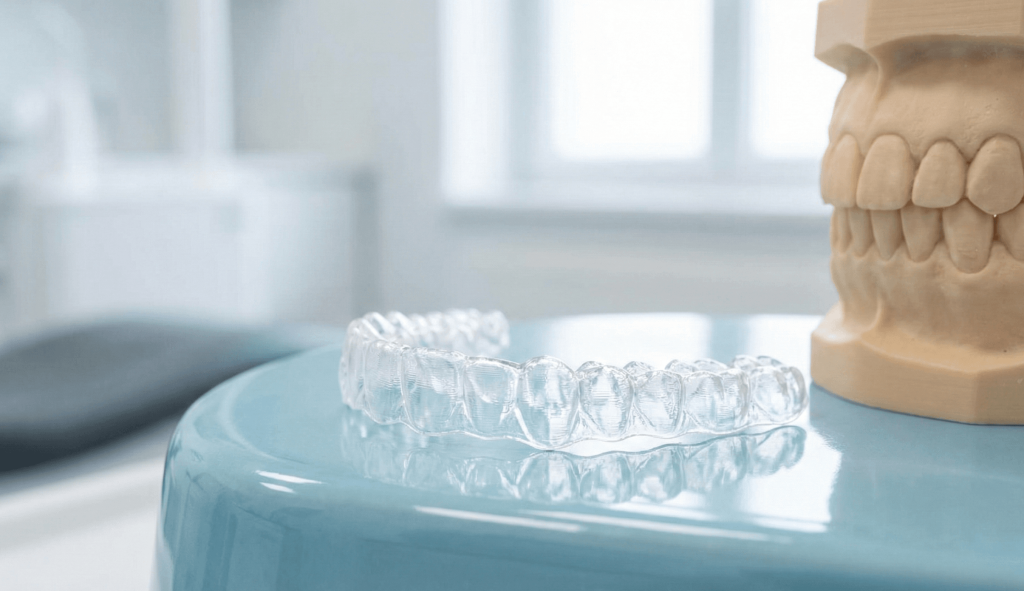
What Are Clear Aligners Made Of?
Clear aligners are made from specified dental polymers, but their material labels do not all describe the same thing. PETG identifies a copolyester family. TPU means thermoplastic polyurethane. Multilayer describes how a sheet is built and may combine different polymer layers. A useful comparison therefore needs both the formulation and the construction of the exact product.
Patients generally need to know what will be used in their prescribed trays and how to care for it. Dental practices and laboratories also need the intended use, processing instructions, traceability and supporting test information. “Premium plastic” does not answer either set of questions.
PETG, TPU and Multilayer: A Practical Comparison
| Label | What it describes | What to check before comparing products |
|---|---|---|
| PETG / copolyester | A polymer family; the exact composition is product-specific. | Intended dental use, exact grade, processing requirements and the evidence for the finished application. |
| TPU / polyurethane | A polymer family with product-specific formulations. | Do not infer identical flexibility, durability or clinical behaviour from the family name. |
| Multilayer | A layered construction that can combine different components. | Layer design, material identification, handling instructions and the products used as comparators in testing. |
| Branded formulation | A named commercial product that may use a proprietary formulation. | The manufacturer's current technical documents, intended use and availability for your receiving workflow. |
These categories can overlap. A multilayer sheet is not a separate chemical family competing directly with every TPU sheet. Likewise, the term “single-layer” does not mean that a product is poor quality. Compare named products designed for the same task, using equivalent evidence.
Read Force, Durability and Clarity Claims Carefully
Ask for the test method before treating a percentage as a buying advantage. Useful questions include: what was the comparison material, was the sample formed, how was it conditioned, and how long did testing last? A result for an unformed sheet or a short laboratory interval should not be presented as a guaranteed result throughout treatment.
A manufacturer technical page describes a named multilayer product as a trilaminate material with an elastomeric core and outer shells, and publishes material-test information with conditions and footnotes. That is evidence about a named product and test setup. It does not establish that every multilayer material performs the same way or that a particular patient will finish faster.
- What exact product and thickness were tested?
- Was the comparison made under the same conditions?
- Is the outcome a material measurement, a manufacturing observation or a patient outcome?
- Is the evidence independent research, manufacturer testing or a marketing statement?
- Does the claimed benefit match the intended use in your practice?
Comparing Materials for Your Aligner Workflow?
Ask our team about the exact sheet grade, intended use, available documentation and production requirements for your proposed case workflow.
[email protected]Check the Manufacturing Requirements
A sheet specification and a finished appliance specification are different records. Ask how the laboratory identifies the starting material, follows the relevant processing instructions and checks the completed trays. Keep the approved material and protocol associated with the case rather than substituting a similarly labelled sheet without review.
For a purchasing comparison, request the sheet size and thickness, compatible equipment, storage and handling requirements, relevant drying or forming instructions, and the process for reporting a quality issue. Supplier documentation should make clear which instructions belong to the exact product ordered.
Compare the material alongside our guides to single-layer and multilayer aligner sheets and quality control in aligner production. Those are related decisions: the sheet choice and the way it is processed both need an identifiable specification.
What Safety and Regulatory Documents Should You Ask For?
Ask for documentation for the named material and its intended use, rather than relying on a general badge or an ingredient slogan. A statement such as BPA-free answers a limited composition question; it does not establish that every wearer will experience no irritation or sensitivity.
The FDA explains that registration and product authorization are different. For a US regulatory claim, identify the relevant product and authorization record. Other markets have their own requirements. The regulatory status of a material supplier should not automatically be attributed to every finished appliance made from it.
Patients with a known material sensitivity should discuss it with the treating clinician. If an appliance causes an unexpected reaction or does not fit as directed, seek a clinical assessment instead of relying on a materials article to decide what to do.
Aligner Material and Retainer Material Are Different Choices
Active trays are prescribed to move teeth in stages; retainers are prescribed to maintain the result. The exact product's intended use matters when a laboratory chooses a sheet for either task.
For example, A provider's material documentation distinguishes the product selected for its active aligners from the one selected for its retainers. This is an example of a documented provider workflow, not a rule requiring every practice to use those two products.
Patients should ask which retainer is prescribed and how replacement is arranged. Our retainers after clear aligners guide covers the package and aftercare questions to discuss before treatment finishes.
A Material Selection Checklist for Your Practice
- Name the application. Specify active aligners, retention or another appliance before requesting recommendations.
- Identify the product. Record the manufacturer, grade, thickness and intended use.
- Read the evidence. Separate supplier descriptions from measured data and patient-outcome research.
- Confirm the process. Match the material instructions to the equipment and quality checks in your laboratory.
- Keep traceability. Define how the product and batch are recorded and how quality concerns are handled.
- Review before changing. Have the responsible clinical and production teams assess a proposed material substitution.
Our product information covers a specified multilayer sheet product and multilayer clear aligner sheets. Ask our team for the current product documentation and suitability for your proposed workflow; a listing alone is not a substitute for the instructions and clinical prescription.
Frequently Asked Questions
What are the differences among clear aligner materials?
Is multilayer aligner material always better than single-layer material?
What does multilayer aligner material mean?
Does a sheet thickness equal the finished aligner thickness?
Does BPA-free mean an aligner cannot cause irritation?
Can the same material be used for aligners and retainers?
Worldwide

Choose Materials With Clear Documentation
Discuss material options, product specifications and manufacturing requirements with our team before placing an order or changing an established workflow.
[email protected]