
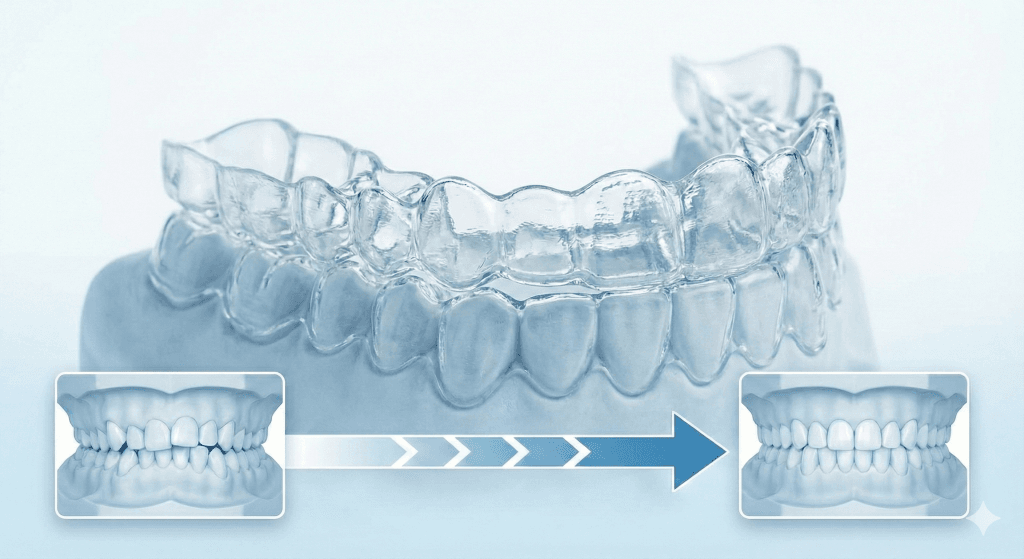
Clear aligner treatment depends on far more than digital planning and tooth movement simulations. One of the most critical—but often overlooked—factors is the aligner material itself. The way an aligner material behaves inside the mouth directly affects force delivery, comfort, tracking accuracy, and overall treatment success.
Multi-layer aligner materials have emerged as a major advancement in orthodontics because they address the mechanical limitations of traditional single-layer plastics. By combining different material properties into one aligner, multi-layer designs support more predictable and efficient tooth movement.
Why aligner material plays a critical role in treatment success
Aligners are exposed to constant mechanical and environmental stress. Once placed, they must apply controlled forces for several days while facing:
Temperature changes from food and drinks
Moisture and saliva
Repeated insertion and removal
Chewing forces and pressure from attachments
At the same time, aligner materials are viscoelastic, meaning they naturally lose force over time and can slowly deform under constant stress. If the material relaxes too quickly or loses its shape, tooth movement becomes less predictable.
This is where material engineering becomes essential.
What are multi-layer aligner materials?
Multi-layer aligner materials are engineered using two or three bonded layers, each designed to perform a specific function. Instead of relying on one material to do everything, multi-layer systems divide responsibilities across layers.
A typical structure includes:
Outer layers: Provide strength, shape stability, and resistance to cracking or deformation
Inner layer: Offers elasticity, flexibility, and improved adaptation to tooth surfaces
This layered approach allows the aligner to remain strong and controlled while still being comfortable and responsive during wear.
1. More consistent force delivery throughout wear time
One of the biggest challenges in aligner therapy is force decay. Many materials deliver high force at insertion but lose effectiveness rapidly over time. When force drops too quickly, teeth may stop tracking as planned.
Multi-layer materials help reduce this problem by:
Supporting gradual, sustained force release
Stabilizing the aligner structure so activation lasts longer
Minimizing rapid stress relaxation
More consistent force over the full wear period leads to better alignment accuracy and fewer interruptions in treatment.
2. Improved tracking through better shape retention
Tracking depends on how well an aligner maintains its designed shape and fit on the teeth. Even small distortions can reduce contact with attachments and limit effective tooth movement.
Multi-layer materials improve tracking by:
Holding their geometry more reliably
Resisting unwanted deformation during wear
Recovering their shape after insertion and removal
This improved shape memory helps ensure that aligners remain fully engaged on the teeth, especially during complex movements like rotations, extrusions, and torque control.
3. Better balance between comfort and control
Comfort is a major factor in patient compliance, especially during the first days of each aligner stage. Stiffer materials can cause discomfort, while softer materials may compromise movement control.
Multi-layer designs address this balance by:
Using elastic inner layers to reduce sharp pressure peaks
Maintaining firm outer layers for mechanical control
The result is an aligner that feels smoother when seated but still applies the forces needed for effective tooth movement.
4. Increased durability and resistance to tearing
Aligners are subjected to high stress around:
Attachments
Sharp tooth edges
Areas that flex during insertion and removal
Single-layer materials may be more prone to tearing or cracking in these areas. Multi-layer constructions enhance durability by distributing stress across layers rather than concentrating it in one.
Improved tear resistance reduces aligner failures, delays, and the need for replacements during treatment.
5. Stable performance in real oral conditions
The oral environment is challenging for polymers. Heat, moisture, and mechanical stress can all change how materials behave over time.
Multi-layer aligner materials are designed to perform more reliably under these conditions by combining:
Elasticity for controlled movement
Structural strength for long-term stability
Resistance to environmental deformation
This stability helps aligners behave closer to how they were designed throughout the wear cycle.
6. Thickness alone does not define performance
A common misconception is that thicker aligners always provide better control. While thickness does influence force levels, material behavior is just as important.
Two aligners of the same thickness can perform very differently due to:
Polymer composition
Layer structure
Stress relaxation characteristics
Shape recovery ability
Multi-layer engineering allows manufacturers to optimize performance without simply increasing thickness, helping keep aligners comfortable and discreet.
Common material families used in aligners
Aligner materials generally fall into categories such as:
Copolyester-based materials: Known for clarity and ease of forming, but may show faster force decay in some applications
Polyurethane-based materials: Known for elasticity, resilience, and suitability for advanced layered designs
Multi-layer systems often combine properties from different material families to achieve a more balanced performance profile.
How multi-layer materials support better treatment outcomes
The clinical benefits of multi-layer aligner materials can be summarized into three key areas:
Predictability
More stable force delivery and improved shape retention support consistent tracking and fewer mid-course corrections.
Patient compliance
Improved comfort and fit encourage patients to wear aligners as prescribed, which directly impacts success.
Treatment efficiency
Greater durability and material stability reduce interruptions caused by damaged or ineffective aligners.
Final thoughts
Multi-layer aligner materials represent a major step forward in clear aligner therapy. By combining strength, elasticity, comfort, and durability into a single system, they address many of the mechanical challenges that limit treatment predictability.
In modern orthodontics, material science is not a secondary detail—it is one of the foundations of successful clear aligner treatment.