
Why Biomechanics Decide Whether an Aligner Case Succeeds
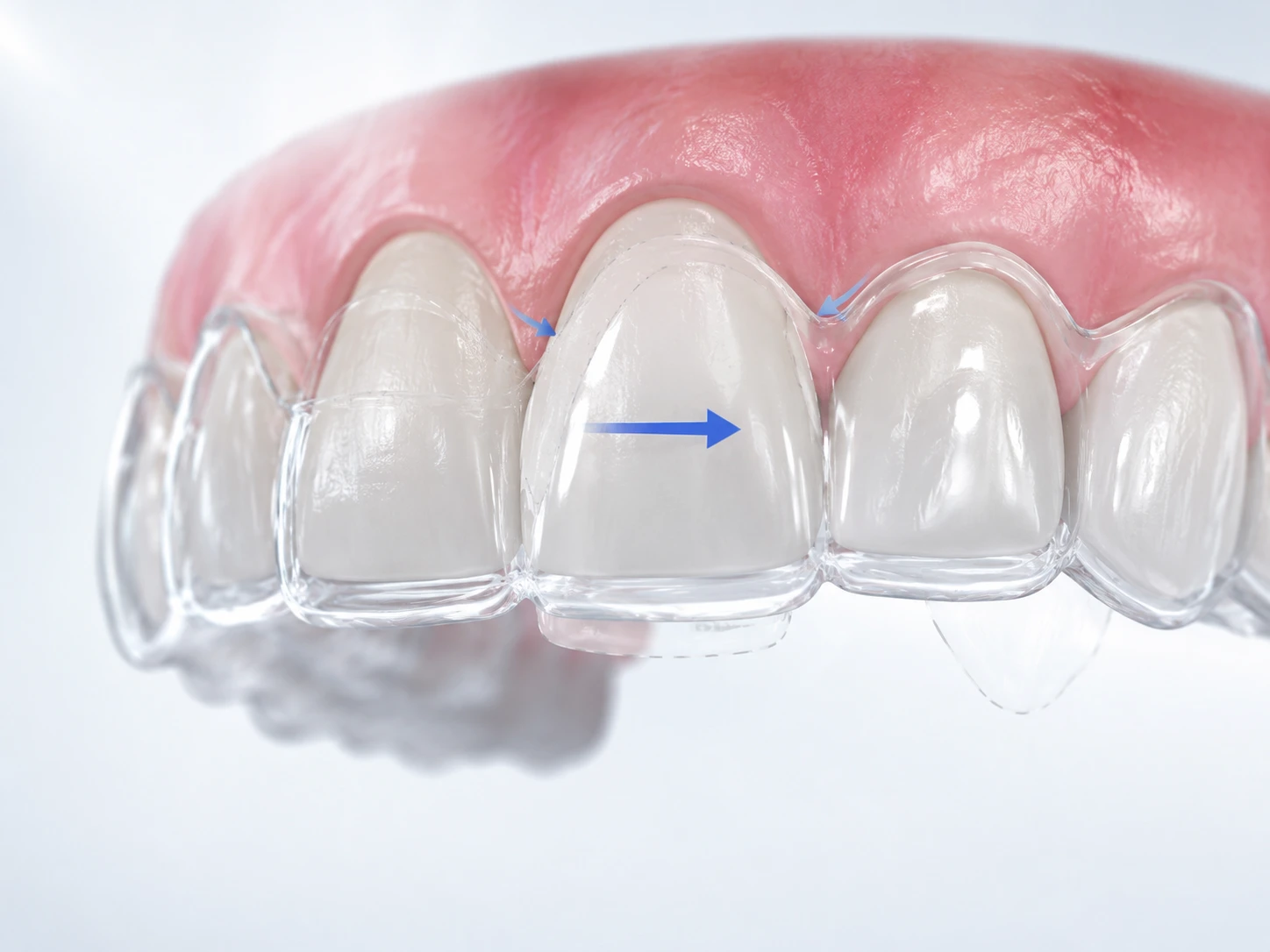
A clear aligner is a passive piece of thermoformed plastic. It has no motor, no wire tension to adjust, and no way to "know" what it is supposed to do. Every result it produces comes from one thing: the shape difference between the current position of the teeth and the position designed into the next tray. Tooth-movement biomechanics is the study of how that shape difference is translated into controlled, predictable movement — and it is the single most important factor in whether a case finishes the way the 3D plan promised.
This is the part of the workflow where clinical judgment matters most. Two treatment plans can target the exact same final smile, yet one tracks beautifully while the other leaves teeth lagging in their trays, forcing mid-course corrections and refinements. The difference is almost never the plastic. It is the biomechanical decisions made in the digital setup: which movements were assigned, in what order, with what attachments, and how much margin was built in to absorb inefficiency.
To understand why some cases are routine and others are genuinely hard, you first have to understand the vocabulary of tooth movement itself.
The Six Fundamental Tooth Movements
Orthodontic movement, no matter how complex the final case looks, is built from six basic movement types. Every tooth in a treatment plan is assigned some combination of these, and each one places a different demand on the aligner.
1. Tipping
Tipping is the simplest movement. The crown tilts in one direction while the root stays relatively fixed, so the tooth rotates around a point near its apex. Because an aligner naturally applies its force at the crown, tipping is what it wants to do by default. This is why minor crowding and small spacing cases — which are mostly crown tipping — are the most predictable work an aligner does.
2. Bodily Translation
In bodily movement, the crown and root move together in the same direction, keeping the tooth upright as it shifts. This is far harder than tipping because it requires a force couple — a balanced system of forces that moves the root along with the crown rather than letting the crown tip ahead. Translation almost always needs a well-placed attachment to control the root, and over long distances, such as closing an extraction space, it becomes one of the most demanding movements in aligner therapy.
3. Rotation
Rotation turns a tooth around its own long axis. The difficulty here depends heavily on tooth shape. Flat-surfaced teeth like incisors give the aligner plenty of surface to grip and rotate. Round, conical teeth — canines and premolars — are the problem: the tray tends to slip over their smooth surface instead of turning them, which is why these teeth almost always require a dedicated rotation attachment.
4. Intrusion
Intrusion pushes a tooth deeper into the bone, in an apical direction. Anterior intrusion to correct a deep bite is achievable with good planning, but intruding posterior teeth is significantly harder and slow to express. Intrusion is often supported with bite ramps and careful anchorage management across the arch.
5. Extrusion
Extrusion pulls a tooth outward from its socket, in the occlusal direction. This is one of the hardest movements for any aligner, because plastic is good at pushing teeth but poor at pulling them. Producing reliable extrusion usually requires optimized extrusion attachments, and in stubborn cases, auxiliary buttons with elastics. It is a movement that is routinely over-corrected because so little of it expresses per stage.
6. Torque (Root Angulation)
Torque describes moving the root buccally or lingually while the crown stays in position — effectively changing the inclination of the tooth. Maxillary incisor torque during space closure is the classic challenge: without proper control, the crowns tip lingually instead of the roots moving as intended. Controlling torque requires force couples engineered through attachments and power ridges built into the aligner.
- Tipping — crown tilts, root fixed. The aligner's natural, easiest movement.
- Translation — crown and root move together. Needs a force couple and attachments.
- Rotation — turning around the long axis. Hard on round teeth without grip.
- Intrusion — moving the tooth into bone. Manageable anteriorly, hard posteriorly.
- Extrusion — pulling the tooth out of the socket. Among the hardest for plastic.
- Torque — angling the root while the crown stays. Demands precise force control.
Predictable vs. Difficult Movements: Where Aligners Excel and Struggle
Decades of clinical experience and a growing body of research have made the picture clear: aligners are highly predictable for some movements and notoriously inefficient at others. Understanding this hierarchy is what separates a plan that tracks from one that disappoints.
The table below summarizes how the fundamental movements rank in difficulty, why, and the typical biomechanical support each one needs.
| Movement | Predictability | Why | Typical Support |
|---|---|---|---|
| Crown Tipping | High | Aligner force is naturally applied at the crown | Often none required |
| Incisor Rotation | High | Flat surface gives the tray good grip | Minor attachments if any |
| Anterior Intrusion | Moderate | Favorable mechanics for bite opening | Bite ramps, anchorage control |
| Bodily Translation | Moderate–Low | Requires a force couple to control the root | Attachments, careful staging |
| Canine / Premolar Rotation | Low | Round crowns let the tray slip | Rotation attachments, overcorrection |
| Root Torque (Incisors) | Low | Pure root movement needs precise couples | Power ridges, attachments |
| Extrusion | Low | Plastic pushes well but pulls poorly | Optimized attachments, buttons + elastics |
None of the "low predictability" movements are impossible — modern aligners achieve all of them every day. But they only succeed when the treatment plan compensates for the biomechanical disadvantage with the right auxiliaries and staging. Left unsupported, these are exactly the movements that cause teeth to fall out of their trays.
Need Treatment Plans That Account for the Hard Movements?
Our orthodontic planning team designs the attachments, staging, and overcorrection that make difficult cases track — so you spend less time on refinements.
[email protected]The Hardest Movements, Explained
It is worth looking more closely at the three movements that cause the most trouble, because they appear in a large share of real cases — and they are where treatment planning skill earns its keep.
Rotating Round Teeth
A canine or premolar has a smooth, conical crown with very little flat surface for an aligner to push against. When the tray tries to rotate the tooth, it simply slides over the surface and the movement does not express. The solution is a composite attachment — typically a beveled or optimized rotation attachment — bonded to the tooth to create a defined contact point the aligner can engage. Severe rotations are also broken into smaller per-stage increments and over-corrected, because even with an attachment, full expression rarely happens on the first pass.
Extruding Teeth
Extrusion is biomechanically the opposite of what a tray does naturally. The aligner seats over the teeth and pushes down and in; pulling a tooth up and out of its socket is something plastic does poorly on its own. To make extrusion track, planners place optimized extrusion attachments that let the tray grab and lift the tooth, and in difficult cases add bonded buttons with elastics for additional vertical force. Extrusion is also one of the most heavily over-corrected movements in any well-built plan.
Closing Extraction Spaces and Controlling Roots
Moving a tooth bodily across a large extraction space, while keeping its root upright and torqued correctly, combines several of the hardest demands at once: translation, anchorage control, and torque. This is where inexperienced planning shows up most visibly — crowns tip into the space while roots are left behind, producing a poor final result and an unstable bite. Strong biomechanical planning sequences these movements deliberately, uses attachments to control the roots, and stages anchorage so the right teeth hold while others move.
How Attachments and Auxiliaries Make Hard Movements Possible
If the fundamental movements are the "what," the auxiliaries are the "how." These are the tools a treatment planner uses to overcome the biomechanical limits of plastic and deliver controlled force exactly where it is needed.
- Composite Attachments Small tooth-colored composite shapes bonded to specific teeth, giving the aligner a defined surface to push or pull against. Conventional attachments (rectangular, beveled) and optimized attachments are matched to the movement — rotation, extrusion, root control, or bodily translation.
- Power Ridges Pressure features built directly into the aligner that apply a force couple for root torque, most often used to control the inclination of upper incisors during space closure without bonding an external attachment.
- Interproximal Reduction (IPR) Carefully measured enamel reduction between teeth to create the space needed to resolve crowding or align rotations. Not a movement itself, but a prerequisite that the plan marks stage by stage.
- Bite Ramps and Buttons with Elastics Bite ramps assist with deep-bite correction and disclusion; bonded buttons paired with elastics add directional force for extrusion, anchorage, or anteroposterior correction that the tray alone cannot deliver.
- Staging and Overcorrection The sequence in which teeth move, how much movement is assigned per aligner, and the deliberate margin built in beyond the target. This is the connective tissue that ties every auxiliary together into a plan that actually tracks.
The key point for any dentist or aligner brand is that these tools are only as good as the judgment applied in placing them. An attachment in the wrong position, or a movement staged too aggressively, can hurt a case as easily as the right choice helps it. Biomechanics is not a checklist — it is a set of decisions made tooth by tooth, stage by stage.
What This Means When You Choose a Treatment Planning Partner
For dentists offering aligners, dental labs producing them, and brands building an aligner line, biomechanics is not an abstract clinical topic — it is the difference between a profitable, low-friction case and one buried in refinements. A treatment plan that ignores the hard movements looks fine on screen and fails in the mouth.
This is precisely why the quality of your treatment planning is a clinical decision, not an administrative one. A planning team that genuinely understands force systems will assign movements realistically, place attachments where the biomechanics demand them, sequence anchorage correctly, and build in the overcorrection that difficult movements require. The payoff is cases that track as designed — fewer mid-course corrections, fewer refinement rounds, and a more predictable experience for both the doctor and the patient.
At Clear Moves Aligners, every plan is designed by experienced orthodontic treatment planners who engineer the biomechanics — attachments, staging, and overcorrection — into the 3D setup before a single aligner is manufactured. For dentists, that means more confident case acceptance. For labs and aligner brands, it means a planning partner whose setups are built to finish.
- Every case is built from six movements: tipping, translation, rotation, intrusion, extrusion, and torque.
- Aligners excel at tipping and flat-tooth rotation but struggle with extrusion, round-tooth rotation, and root torque.
- Attachments, power ridges, IPR, and elastics exist to give plastic the force control it otherwise lacks.
- Staging and overcorrection compensate for biomechanical inefficiency and relapse.
- Planning expertise is the real variable — it determines whether a case tracks or ends up in refinement.
Frequently Asked Questions
What are the basic types of tooth movement in clear aligner treatment?
Which tooth movements are hardest for clear aligners to achieve?
Why is rotating a canine or premolar difficult with aligners?
What are attachments and why do treatment plans use them?
Can clear aligners move the root of a tooth, not just the crown?
What is overcorrection and why is it built into treatment plans?
How does treatment planning expertise affect whether an aligner case tracks?
Worldwide

Get Treatment Plans Engineered to Finish
Talk to our orthodontic planning team about how we build attachments, staging, and overcorrection into every 3D setup — for dentists, labs, and aligner brands.
[email protected]