
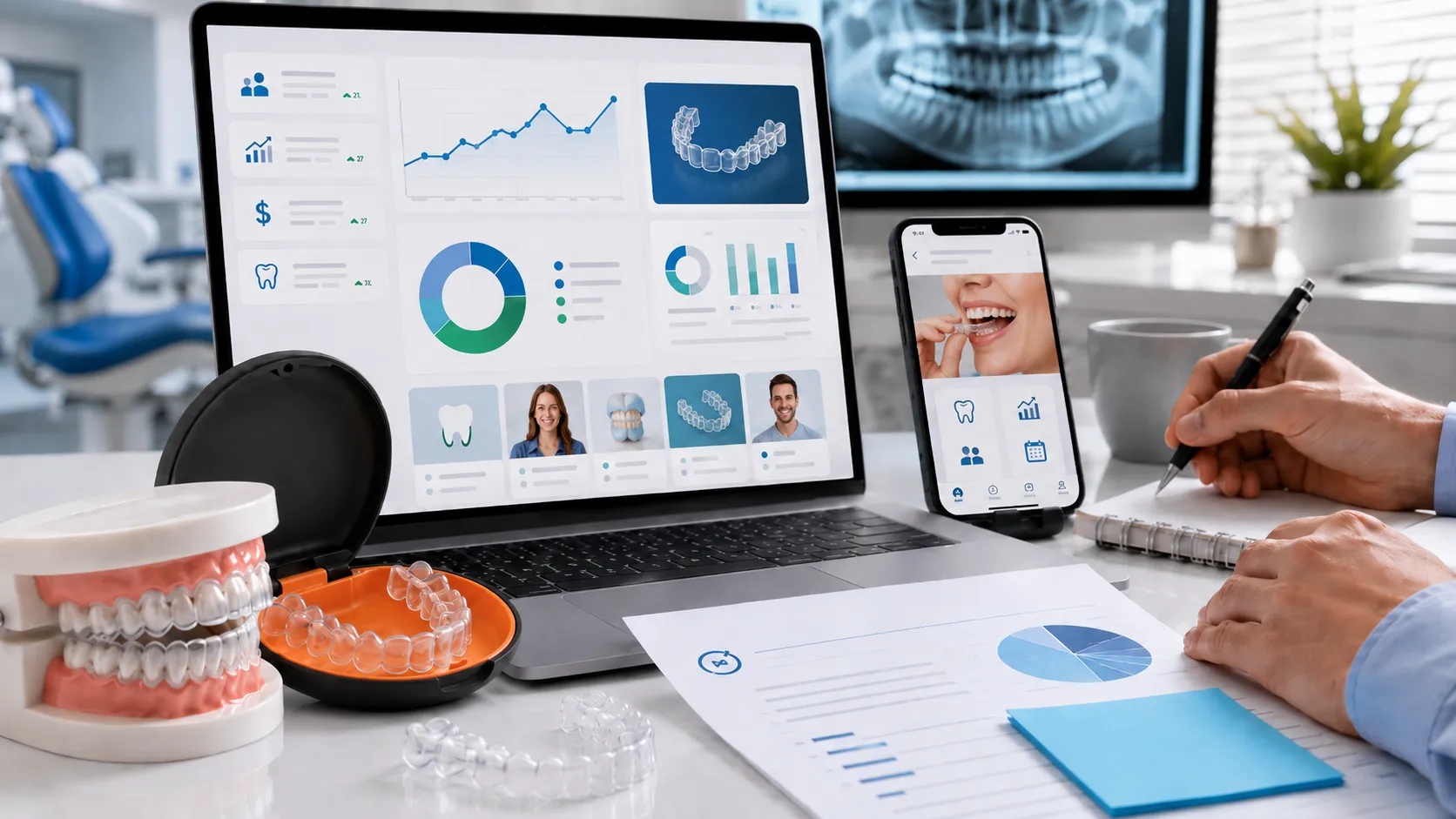
Why Case Acceptance — Not Demand — Is Your Real Growth Lever
Most practices believe their clear aligner numbers are flat because of a demand problem. The truth is almost always the opposite. Candidates walk through your door every single day — the adult who covers their mouth when they laugh, the parent eyeing their teen's crowding, the patient who mentions a relapse from braces they had in high school. The gap that limits your growth is not how many suitable patients you see. It is how many of them actually start treatment. That gap is your case acceptance rate, and it is the single most controllable lever in your practice.
Consider the math. If you identify ten aligner candidates a week and convert three, lifting your acceptance rate from 30% to 50% does not add two cases — it adds another two cases per week, roughly a hundred a year, without a single new patient, ad dollar, or operatory. That is why marketing clear aligners to your patients has very little to do with billboards and everything to do with the conversation that happens in the chair. The demand already exists. Your job is to convert it with clarity and confidence.
This guide is built around that reality. We will cover why patients hesitate, how to set the stage before you ever say the word "aligners," a repeatable five-step consultation script, word-for-word responses to the objections you hear most, the visual and financial tactics that quietly do your selling for you, and how to turn a single "yes" into a loyal, referring patient for life.
Why Patients Say No: The Psychology Behind a Stalled "Yes"
You cannot improve case acceptance until you understand what a "no" actually means. Patients rarely turn down clear aligners because they do not want straighter teeth — almost everyone does. They hesitate for a small set of predictable, emotional reasons. When you learn to hear the real objection underneath the surface words, you stop reflexively dropping your price and start responding with the right tactic.
The Five Hidden Reasons Behind a "No"
Nearly every stalled case traces back to one of these five drivers. Most patients will not name them out loud, so part of your job is to diagnose which one is in play.
- Perceived value gap: The fee feels high relative to a benefit they don't yet fully understand. This is a value problem, not a price problem.
- Fear and uncertainty: They're anxious about discomfort, the look of treatment, the time commitment, or whether it will even work for them.
- No urgency: Crooked teeth don't hurt today, so "later" feels safe. Without a reason to act now, "later" becomes never.
- Decision overwhelm: Too many choices — braces vs. aligners, brands, payment options — and the brain defaults to doing nothing.
- Low trust or rapport: They don't yet feel that you understand their goal, so a recommendation feels like a sales pitch.
Notice that only one of these — the perceived value gap — is even adjacent to money, and even that one is about value, not the number itself. When a practice responds to every hesitation by discounting, it trains patients to wait for a deal and erodes the very margin that makes aligners worth offering. The skilled response is to identify which driver is active and address that. A fearful patient needs reassurance and a visual. An overwhelmed patient needs you to simplify and recommend. A patient who sees no urgency needs to understand the cost of waiting.
Set the Stage Before You Say a Word: Pre-Consultation Tactics
The most effective marketing for clear aligners happens before the formal treatment conversation ever begins. By the time you sit down to present a plan, the patient should already be primed — aware that you offer aligners, comfortable in your environment, and gently prompted to think about their smile. Case acceptance is a team sport, and the warm-up belongs to everyone.
Train the Whole Team to Speak One Language
If the dentist is the only person who ever raises, explains, and closes an aligner case, you are leaving most of your potential on the table. The front desk sets the tone on the phone and at check-in. Hygienists and assistants spend more time with patients than anyone and are often first to spot a candidate. A treatment coordinator can carry the financial conversation after your clinical recommendation. When every team member uses consistent, confident language — and knows exactly when to hand off — acceptance rates climb. Run short role-play sessions until the scripts feel natural rather than rehearsed.
Ask the Smile Question — Every Time
Build one simple, open-ended question into your intake and hygiene routine: "Is there anything about your smile you'd change if you could?" It is non-judgmental, it invites the patient to express a goal in their own words, and it hands you the emotional driver you'll use later in the consultation. A patient who says "I've always hated this gap" has just told you exactly how to frame their treatment — and made it their idea, not your pitch.
Make It Visual in the Operatory
Patients believe what they can see. A before-and-after library on the operatory screen, an intraoral camera image of their own crowding, a tablet showing a quick outcome simulation — these do more persuading than any brochure. The goal is for patients to encounter your aligner offering visually and casually long before the formal discussion, so the recommendation feels like a natural next step rather than a surprise. (For a refresher on the patient-facing benefits worth highlighting, see our overview of the top benefits of clear aligners.)
The Case Acceptance Conversation: A Five-Step Script Framework
When it is time for the formal conversation, a repeatable structure beats improvisation every time. The framework below moves the patient from curiosity to commitment in a way that feels like guidance, not pressure. Use it as a backbone, then adapt the wording to your voice.
- 1. Discover — Ask, Don't Tell Open with questions, not features. "What made you mention your smile today?" and "How long has that bothered you?" surface the emotional driver. Let the patient describe the problem in their own words before you say anything about treatment.
- 2. Show — Let Them See It Run an intraoral scan and pull up a treatment simulation or before-and-after. Seeing their own teeth on screen — and a preview of the result — does more to sell the case than any explanation. Visuals turn an abstract idea into a personal, desirable outcome.
- 3. Educate — Connect to Health and Lifestyle Frame aligners as more than cosmetic. Straighter teeth are easier to clean, wear more evenly, and protect long-term oral health. Tie the benefit to their stated goal — confidence at work, a wedding photo, eating without self-consciousness.
- 4. Present — Recommend, Don't Offer a Menu State your recommendation with confidence: "Based on what I'm seeing, clear aligners are the right solution for you." Avoid laying out five options that paralyze the decision. Assume the yes, then move to the practical details of starting.
- 5. Resolve and Start — Make Saying Yes Easy Address any objection (see the next section), present the fee paired with a monthly payment figure, and create a clear path to begin today. The momentum from the scan is perishable — book the start or take the records before the patient leaves the chair.
The most common mistake is collapsing all five steps into a rushed price quote. Each step does a job: discovery builds trust, showing creates desire, education justifies the investment, the recommendation removes choice paralysis, and resolution makes the yes frictionless. Skip a step and you reintroduce one of the five hidden objections.
Want Aligners That Carry Your Brand?
Offering clear aligners under your own practice name makes every "yes" build loyalty to you. Our team helps dental practices launch white-label aligner programs with full treatment-planning support.
[email protected]Word-for-Word Scripts for the Five Most Common Objections
Objections are not rejections — they are requests for more information or an easier path forward. The table below maps each common objection to what the patient is really saying and the one-line reframe that opens the door. Beneath it, you'll find the full word-for-word scripts.
| What They Say | What They Really Mean | Your Reframe |
|---|---|---|
| "It's too expensive." | I don't yet see the value, or I don't know how I'd pay for it. | Shift to daily cost + financing + long-term health. |
| "Let me think about it." | I'm unsure, or no one gave me a reason to decide now. | Uncover the real hesitation and add gentle urgency. |
| "Can't I get it cheaper online?" | I don't understand what the in-office difference buys me. | Contrast supervised care with unmonitored mail-order risk. |
| "Is it really better than braces?" | I want reassurance that this choice is the right one. | Affirm the fit for their case and lifestyle. |
| "I've lived with it this long." | I feel no urgency and I'm minimizing the problem. | Surface the cost of waiting, kindly. |
"It's Too Expensive"
Never apologize for your fee or rush to discount. Acknowledge, then reframe to value and payment.
"Let Me Think About It"
This usually hides an unspoken concern. Don't push — invite it into the open.
"Can't I Get It Cheaper Online?"
Direct-to-consumer aligners have well-documented limitations. Contrast — don't disparage.
"Is It Really Better Than Braces?"
The patient wants confidence in their choice. Affirm it for their situation.
"I've Lived With It This Long"
Gently introduce the cost of inaction without judgment.
Visual & Financial Tactics That Lift Acceptance
Two categories of tactic move the needle more than anything else: helping the patient see the outcome, and making the investment feel achievable. Master both and your scripts do far less heavy lifting.
Let the Visuals Do the Selling
Abstract benefits don't convert; concrete images do. The moment a patient sees their own crowded teeth on the operatory monitor — then a simulation of the straightened result — desire is created without a word of persuasion. Lean on an intraoral scan of their actual mouth, a side-by-side outcome preview, and a curated before-and-after gallery of cases from your own practice. Real, local results carry more weight than stock photos because the patient pictures themselves in them. (The precision of modern digital treatment planning and aligner manufacturing is exactly what makes these simulations credible.)
Present the Fee With Confidence
How you present a number matters as much as the number itself. Lead with your recommendation, then anchor the value before naming the price — against the lifetime cost of leaving misalignment untreated, or the comparable cost of traditional braces. Always pair the total fee with a monthly figure, because patients buy the monthly payment, not the lump sum. And deliver it without flinching: when a clinician hesitates or over-explains the fee, patients read it as a signal the treatment may not be worth it.
Remove the Money Obstacle
Financing is not a discount — it is a bridge. In-house membership plans, third-party patient financing, and flexible payment schedules let patients say yes to a result they want without the lump sum standing in the way. Offering a small, time-bound reason to start now — locking in current pricing, or beginning with a same-day scan — converts the patients who would otherwise drift into "later." A same-day start rate is one of the most underrated metrics in the practice; the longer the gap between consultation and start, the more cases evaporate.
From One "Yes" to Lifetime Loyalty and Referrals
Case acceptance gets the patient started. What you do next determines whether they become a one-time transaction or a loyal advocate who sends you their friends, family, and coworkers. This is where the practice-growth angle compounds — because a great aligner experience is one of the most referral-generating things you can deliver.
Own the Brand, Own the Loyalty
When you offer aligners under a national brand, the patient credits the brand for their new smile. When you offer them under your practice name through a white-label manufacturer, the patient credits you — and there's no brand name for them to comparison-shop elsewhere. Owning the brand strengthens loyalty, gives you control over pricing and the patient experience, and keeps the entire relationship inside your practice. Learn how a white-label clear aligner program works, and if you operate multiple sites, see our guide to clear aligners for DSOs.
Engineer the "Wow" Moment
Reveal day — when the patient first sees their finished result — is the single highest-emotion point of the entire journey, and the perfect moment to ask for a referral or review. A patient who is delighted and present is far more likely to act than one you email three weeks later. Build a simple, repeatable ask into your protocol: capture the before-and-after, celebrate the result, and invite them to share it.
- Branded experience: Custom packaging, retainer cases, and materials make the journey feel premium and uniquely yours.
- Proactive check-ins: Scheduled progress touchpoints (in person or remote) reassure patients and reduce mid-treatment drop-off.
- Retention as recurring revenue: Retainers and periodic re-checks keep patients in your orbit — and protect their result from relapse.
- The reveal-day ask: Request the referral or review at peak delight, not weeks later when the emotion has faded.
- Close the loop: Turn happy results into a steady stream of social proof that warms up your next round of candidates.
Measure What Matters: Case Acceptance KPIs
You cannot improve what you don't track. A handful of metrics, reviewed regularly, will tell you exactly where cases are being won and lost — and turn case acceptance from a vague hope into a managed system. Review these monthly with your team, and use the gaps to drive role-play and script refinement.
| Metric | What It Tells You | Why It Matters |
|---|---|---|
| Case Acceptance Rate | % of qualified candidates who start treatment | The headline number; many growth-focused practices target 50%+. |
| Same-Day Start Rate | % who begin or take records at the consult | Momentum is perishable — the longer the gap, the more cases vanish. |
| Candidate Identification Rate | How often the team spots and raises aligner cases | Reveals whether the whole team is engaged, not just the dentist. |
| Average Treatment Fee | Mean fee per started case | Tracks whether discounting is quietly eroding your margin. |
| Referral & Review Rate | New patients and reviews per completed case | Measures whether the experience is generating loyalty and growth. |
Track these as a trend, not a snapshot. A dip in same-day starts might mean your fee presentation needs work; a low candidate identification rate points to team training; a falling average fee signals you're discounting to win cases you could win with better scripts. The practices that grow aligner revenue fastest are not the ones with the best marketing — they are the ones that measure, coach, and refine the conversation every week.
Frequently Asked Questions
What is case acceptance and why does it matter for clear aligners?
Why do patients say no to clear aligner treatment?
What should I say when a patient says clear aligners are too expensive?
How can a dental practice present clear aligner fees to improve acceptance?
Should the whole dental team be involved in marketing clear aligners?
How does offering your own branded clear aligners build patient loyalty?
What case acceptance rate should a dental practice aim for with clear aligners?
Worldwide

Grow Aligner Cases Without the Manufacturing Headache
Partner with Clear Moves Aligners for certified white-label manufacturing and full treatment-planning support — so your team can focus on case acceptance while we handle the production.
[email protected]