
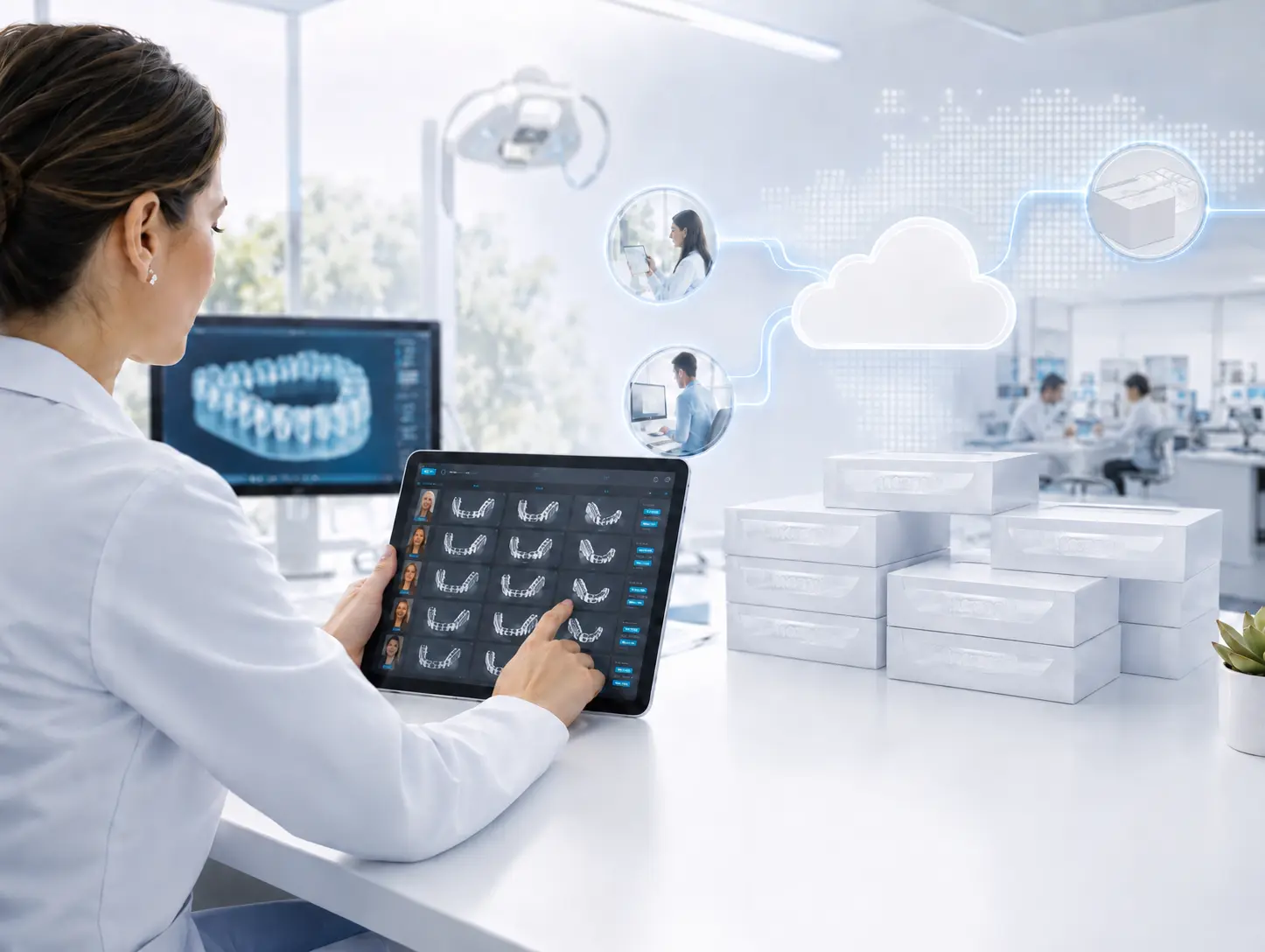
Why Scaling Clear Aligner Cases Is a Growing Priority for Dental Clinics
Dental clinics looking to scale clear aligner cases are responding to one of the most significant shifts in modern dentistry. Patient demand for invisible orthodontic solutions has accelerated year over year, driven by social media awareness, the rise of telehealth consultations, and a population that increasingly values aesthetic dental treatments. For general practices, orthodontic specialists, and cosmetic dentistry clinics alike, aligners represent both a clinical opportunity and a revenue growth lever. The rise of digital orthodontics has only accelerated this shift.
Yet despite the demand, many practices find themselves stuck. They are turning away potential aligner patients, quoting longer timelines than competitors, or avoiding complex cases entirely. The reason is rarely clinical ability — it is operational capacity. When production is the bottleneck, the answer is not always to expand your lab. Sometimes, the smarter move is to rethink your production model altogether.
For clinics ready to capture more of this market, the question is not whether to grow — it is how to grow without creating operational risk. That is where the concept of outsourced clear aligner production becomes transformative.
The In-House Production Bottleneck
In-house aligner fabrication sounds appealing in theory. Full control. Faster turnaround. No middlemen. But the reality for most dental clinics is far less glamorous. Producing clear aligners internally requires a substantial upfront investment and ongoing operational overhead that few practices are prepared to sustain at scale.
The Capital Barrier
Setting up an in-house aligner lab means purchasing thermoforming equipment, trimming and finishing stations, 3D printers for dental models, and the medical-grade aligner material itself. Depending on the quality of equipment, this initial outlay can range from $50,000 to over $200,000. For a clinic processing 10 to 15 cases per month, the ROI timeline stretches uncomfortably long.
The Staffing Challenge
Equipment alone does not produce aligners — trained technicians do. Hiring, training, and retaining lab staff adds a layer of complexity that pulls clinical leadership away from patient care. Technician turnover, sick days, and training ramps create production inconsistencies that directly impact patient satisfaction and case timelines.
The Quality Control Gap
Maintaining the quality standards required for medical-grade clear aligners demands rigorous protocols, calibration schedules, and material handling procedures. Without ISO-certified processes and regulatory oversight, in-house production introduces risk — both clinical and legal — that many practices underestimate until a problem surfaces.
Outsourcing Clear Aligner Production: A Smarter Path to Scale
The most efficient way for dental clinics to scale clear aligner cases without overextending resources is to partner with a certified clear aligner manufacturer. This model separates clinical decision-making from manufacturing execution, allowing dentists to focus entirely on diagnosis, treatment planning oversight, and patient relationships.
Outsourcing aligner production is not about giving up control. It is about strategic delegation. The dentist retains full clinical authority — reviewing treatment plans, approving staging sequences, requesting refinements — while the manufacturing partner handles the rest: digital modeling, aligner fabrication, quality inspection, and logistics.
Why the Model Works
Think of it like radiology. Most dental clinics do not build their own imaging labs. They send scans to specialized diagnostic centers and receive expert reports back. The same logic applies to clear aligner production. You do not need to own the manufacturing process to deliver exceptional orthodontic outcomes. You need a reliable lab partner who meets the same standards you would demand of your own facility — and often exceeds them.
By working with an external manufacturing partner, clinics convert fixed costs (equipment, space, staff salaries) into variable costs that scale proportionally with caseload. Process 5 cases this month, pay for 5. Scale to 50 next quarter, and your partner scales with you — no hiring spree, no equipment upgrade, no growing pains.
- Zero capital investment: No thermoforming equipment, 3D printers, or lab buildout required
- Flexible scaling: Volume adjusts with demand — pay per case, not per month
- Certified quality: FDA, ISO, CE, and regional certifications handled by the manufacturer
- Faster go-to-market: Start offering aligners within weeks, not months of lab setup
- Clinical focus: More chair time with patients, less time managing production workflows
What to Look for in a Clear Aligner Manufacturing Partner
Not all clear aligner lab partners are created equal. The right manufacturer should feel like an extension of your practice — clinically rigorous, responsive, and invested in your growth. Here are the non-negotiable criteria to evaluate.
Regulatory Certifications
Your manufacturing partner must hold the certifications relevant to your market. At minimum, look for FDA 510(k) clearance for the US market, ISO 13485 quality management certification, and CE marking for international compliance. If you serve patients in Australia or the UK, confirm TGA and MHRA registrations as well. These are not optional — they are the baseline for patient safety and legal compliance.
Digital Workflow Compatibility
A modern aligner partner should integrate seamlessly with your existing digital workflow. That means accepting intraoral scans from all major scanner brands (iTero, 3Shape TRIOS, Medit, Carestream), providing a cloud-based portal for case submission and treatment plan review, and delivering detailed 3D treatment simulations that you can share with patients to boost case acceptance.
Treatment Planning Support
The best manufacturing partners offer orthodontic treatment planning support as part of their service. This means a team of qualified dental professionals reviews each case, creates a proposed staging sequence, and presents it for your approval — not just a software algorithm generating a plan without clinical oversight.
White-Label and Private-Label Options
If brand consistency matters to your practice — and it should — look for a partner that offers white-label clear aligners. This allows you to deliver aligners under your own practice branding, reinforcing patient trust and differentiating your clinic from competitors who rely on recognizable third-party aligner brands.
Ready to Scale Your Aligner Cases?
Talk to Clear Moves Aligners about a production partnership tailored to your clinic's growth goals.
[email protected]Step-by-Step: How Clinics Integrate an External Aligner Partner
Moving from in-house production — or launching an aligner service for the first time — through a manufacturing partner is simpler than most clinics expect. Here is a typical integration workflow.
- Initial Consultation and Onboarding The manufacturing partner evaluates your clinic's needs, case volume expectations, scanner compatibility, and branding preferences. A dedicated account manager is typically assigned to guide your aligner treatment workflow.
- Digital Scan Submission After a patient consultation, submit the intraoral scan, clinical photos, and treatment notes through the partner's secure online portal. Most platforms accept submissions in under 5 minutes.
- Treatment Plan Design and Review The partner's orthodontic team creates a detailed 3D treatment simulation showing tooth movement staging. You review, request modifications if needed, and approve the final plan.
- Aligner Fabrication and Quality Inspection Once approved, aligners are fabricated using medical-grade materials in a certified facility. Each set undergoes quality inspection before packaging and dispatch.
- Delivery and Patient Fitting Finished aligner sets are shipped directly to your clinic — typically within 5 to 10 business days. You fit the patient, provide wear instructions, and schedule follow-up appointments as usual.
- Ongoing Support and Refinements If mid-course corrections or refinement aligners are needed, submit updated scans through the same portal. The partner handles redesign and fabrication with the same turnaround process.
In-House vs. Outsourced Clear Aligner Production: A Direct Comparison
To help you evaluate the right approach for your practice, here is a side-by-side comparison of the two production models across the factors that matter most to growing dental clinics.
| Factor | In-House Production | Outsourced to Certified Partner |
|---|---|---|
| Upfront Investment | $50,000 – $200,000+ | None — pay per case |
| Staffing | Requires trained lab technicians | No additional staff needed |
| Certifications | Clinic's responsibility to obtain and maintain | Handled by the manufacturer |
| Scalability | Limited by equipment and staff capacity | Scales with demand automatically |
| Quality Control | Clinic must develop and enforce protocols | ISO-certified QC processes in place |
| Turnaround Time | Same-day possible (if capacity allows) | 5 – 10 business days typical |
| Clinical Control | Full | Full — dentist approves all treatment plans |
| Risk Profile | High fixed costs, regulatory exposure | Low — variable costs, compliance managed |
| Best For | High-volume clinics (50+ cases/month) | Clinics at any volume, especially growing practices |
The comparison makes the economic case clear. Unless a clinic is already processing a very high volume of cases monthly, outsourcing production to a certified partner offers a better risk-to-reward ratio, lower breakeven thresholds, and more operational flexibility. For more insights on the clear aligner industry, explore our blog and resources.
How Clear Moves Aligners Supports Clinic Growth
Clear Moves Aligners was built specifically to serve dental clinics that want to scale their clear aligner cases without the burden of in-house manufacturing. As a certified OEM clear aligner manufacturer, we provide the full production pipeline — from digital treatment planning to finished aligner delivery — so your clinic can focus on what matters: patient care and practice growth.
What Sets Clear Moves Aligners Apart
Every case submitted to Clear Moves Aligners is handled by a team of qualified orthodontic professionals who design treatment plans with clinical precision. Our digital portal makes case submission fast and intuitive, and our treatment simulations give you and your patients full visibility into the projected outcome before a single aligner is fabricated.
We hold FDA 510(k), ISO 13485, CE, EU MDR, TGA, and MHRA certifications — ensuring that every aligner we produce meets the highest international safety and quality standards. Whether your patients are in the United States, Europe, Australia, or the Middle East, our certifications cover your compliance requirements.
Our white-label and private-label programs allow clinics to brand aligners under their own practice name — a powerful differentiator that builds patient loyalty and positions your practice as a full-service orthodontic provider. Combined with competitive per-case pricing and dedicated account management, Clear Moves Aligners is designed to be the silent growth engine behind your practice's aligner success.
Frequently Asked Questions
Can dental clinics scale clear aligner cases without buying thermoforming equipment?
How long does it take to receive aligners from an outsourced manufacturing partner?
Will patients know the aligners are manufactured by a third party?
What certifications should a clear aligner manufacturing partner have?
Is outsourcing clear aligner production more cost-effective than in-house fabrication?
How do clinics maintain clinical control when outsourcing aligner production?
What is the minimum case volume needed to partner with a clear aligner manufacturer?
Worldwide

Scale Your Aligner Cases Today
Partner with Clear Moves Aligners and grow your practice without the overhead of in-house production.
[email protected]