
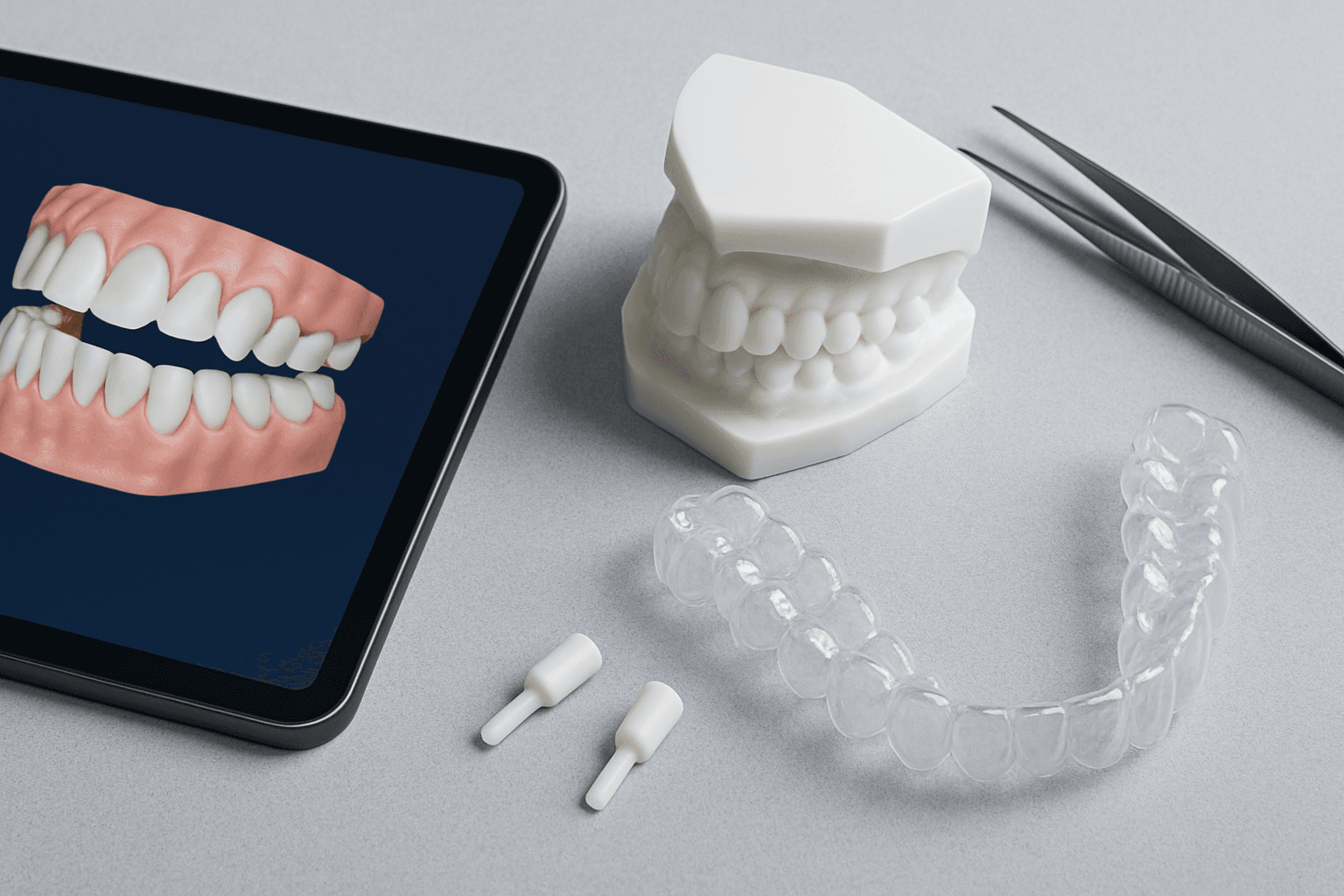
The Myth of the Magic Tray
There's a tempting belief that choosing the right aligner brand is the single most important decision in your orthodontic journey. And to be fair, the material your aligners are made from does matter — advanced multi-layer thermoplastics deliver more consistent force, better comfort, and longer-lasting clarity than cheaper single-layer alternatives.
But here's what orthodontic research consistently reveals: the biggest gap between patients who finish treatment on time with beautiful results and those who don't isn't the aligner technology. It's patient behaviour.
Two people can begin treatment on the same day with identical 3D treatment plans, identical trays, and identical clinical supervision — and end up with drastically different outcomes, purely because of compliance. This article explores the psychological factors that determine clear aligner success and gives you practical, science-backed strategies to stay disciplined from your first tray to your last.
The 20–22 Hour Rule and Why It's Non-Negotiable
If you've started treatment with invisible aligners, your dentist likely told you to wear them for 20 to 22 hours per day. That leaves just 2 to 4 hours for eating, drinking, and oral hygiene. It sounds simple. In practice, it's the single hardest part of treatment.
Each aligner in your series is designed to move your teeth approximately 0.25mm. That movement depends on sustained, consistent force over the entire wear period — typically one to two weeks per tray. When you remove your aligners for longer than necessary, teeth begin drifting back toward their original position. Even a few extra hours out of your mouth each day compounds over weeks and months, leading to a treatment that drags on longer than planned — or worse, requires additional refinement trays.
Understanding the technology behind how aligners work — the controlled, incremental pressure they apply — helps reframe the 20–22 hour rule not as an arbitrary guideline, but as the engineering specification your trays were designed around.
The Psychology Behind Non-Compliance
If compliance is so important, why do patients struggle with it? The answer lies in several well-documented psychological patterns.
Present Bias
Humans are wired to value immediate comfort over future rewards. Removing your aligners to snack, then getting distracted and leaving them out for three hours feels harmless in the moment. The negative consequence — a delayed or compromised result — is invisible and far away. This is the same cognitive bias that makes saving for retirement or going to the gym so difficult. With clear aligner treatment, the reward (a straighter smile) is months away while the cost (mild discomfort, dietary restrictions) is felt right now.
The "Good Enough" Plateau
Around month three or four, many patients notice a visible improvement and unconsciously decide they've achieved "good enough." Wear time slips. Trays stay in the case during social events. But orthodontic treatment isn't linear — some of the most important movements, like root positioning and bite correction, happen in the later stages. Quitting early or reducing compliance at this point can leave you with teeth that look straighter from the front but don't function properly.
Decision Fatigue
Every time you eat, you face a mini-decision: remove the aligners, eat, clean your teeth, put them back. Over the course of a 12-month treatment, that's thousands of individual compliance decisions. Willpower is a finite resource, and without systems in place, fatigue inevitably leads to shortcuts.
Non-compliance is rarely a conscious decision. It's the slow accumulation of small lapses — an extra hour here, a skipped night there — that adds up to weeks of lost treatment time. The solution isn't more willpower; it's better systems.
Identity Shift: Thinking Like a Compliant Patient
Behavioural psychology research suggests that the most effective way to change behaviour isn't to set goals — it's to change your identity. Instead of thinking "I need to wear my aligners 22 hours today" (a task), think "I am someone who takes their orthodontic treatment seriously" (an identity). The distinction is subtle but powerful.
When wearing your aligners becomes part of who you are rather than something you have to do, compliance stops feeling like effort. You don't debate whether to put them back in after lunch — you just do it, the same way you brush your teeth or lock your front door. It becomes automatic.
This shift is easier when you understand the investment you've made. You've chosen a trusted orthodontic solution, your dentist has designed a precise treatment plan tailored to your teeth, and a team of clinical experts has manufactured your trays to exacting standards. Your discipline is the final ingredient that activates all of it.
Five Discipline Strategies That Actually Work
Forget vague advice like "stay committed." These are concrete, evidence-based strategies that patients who finish treatment on time actually use.
Instead of snacking throughout the day, aim for two or three defined meals. Every snack means removing aligners, eating, cleaning teeth, and reinserting — a cycle that eats into your wear time. Patients who eat on a schedule consistently hit the 22-hour mark with ease.
Set a phone alarm every time you remove your aligners. Human time perception is notoriously unreliable — what feels like 30 minutes is often an hour or more. A simple timer closes that gap.
A travel toothbrush, mini toothpaste, and your aligner case should go everywhere with you. Removing friction from the reinsertion process makes it far more likely to happen promptly.
Visual evidence of change is one of the strongest motivational tools available. Side-by-side comparisons from month one to month four can reignite commitment when you hit a motivational plateau.
Your dentist should have shown you a 3D simulation of your final result. Ask for a copy or screenshot. Looking at your future smile when motivation dips reconnects you with why you started.
The Role of Your Dentist in Keeping You Accountable
Clear aligner treatment works best when it's supervised by a qualified dental professional. Unlike direct-to-consumer models where patients are largely left on their own, doctor-led treatment builds accountability into the process. Regular check-ups — typically every six to eight weeks — give your dentist the opportunity to assess whether your teeth are tracking correctly, identify early signs of non-compliance, and adjust the treatment plan if necessary.
This is one of the reasons Clear Moves Aligners prioritises doctor-guided treatment. Every case is reviewed by licensed orthodontic professionals before manufacturing begins, and treatment is monitored throughout. That clinical oversight isn't just a safety measure — it's a compliance mechanism. Knowing you have an upcoming appointment creates a built-in deadline and a sense of accountability that self-directed treatment simply cannot replicate.
If you're unsure how to choose the right aligner provider, look for brands that require in-person check-ups and assign dedicated clinical teams to each case. A provider's certifications and safety standards also matter — FDA, ISO 13485, CE, and TGA approvals signal a commitment to quality that extends beyond the tray itself.
How Technology Supports Patient Discipline
Modern orthodontic technology does more than manufacture precise aligners. It also creates tools that reinforce patient discipline at every stage of treatment.
Advanced 3D imaging and AI-driven treatment planning produce aligner sequences that are biomechanically optimised — meaning each tray does its job efficiently when worn as directed. The treatment timeline your dentist gives you isn't a rough estimate; it's a calculated projection based on precision engineering and predictive analytics. When you comply, the technology delivers. When you don't, the entire sequence can fall out of sync.
Digital monitoring platforms, cloud-based case management portals, and remote progress tracking tools are also changing the game. Patients using Clear Moves Aligners' digital workflow benefit from a system where their treating dentist can review progress remotely and intervene early if things aren't tracking correctly. Keeping pace with the latest trends in digital orthodontics means your treatment benefits from the most current innovations — but none of them replace the fundamental need for consistent daily compliance.
What Happens When You Finish Strong
Patients who maintain consistent compliance through their entire treatment don't just get straighter teeth. They typically finish on schedule (or even ahead of schedule), require fewer refinement trays, spend less money overall, experience less discomfort because teeth track smoothly from one tray to the next, and report higher satisfaction with their final result.
There's also a psychological reward that goes beyond the smile itself. Completing a treatment that demands daily discipline for months builds genuine self-confidence — the kind that comes from knowing you committed to something difficult and followed through. That confidence shows up in every area of life, not just your smile.
Your clear aligners are a precision medical device engineered with advanced materials, 3D treatment planning, and globally certified safety standards. But none of that matters if they're sitting in a case. The most important factor in your treatment isn't the tray — it's the person wearing it.
If you're ready to begin your journey with a provider that combines advanced manufacturing technology with dedicated clinical oversight, explore Clear Moves Aligners and take the first step toward a smile you'll commit to.