
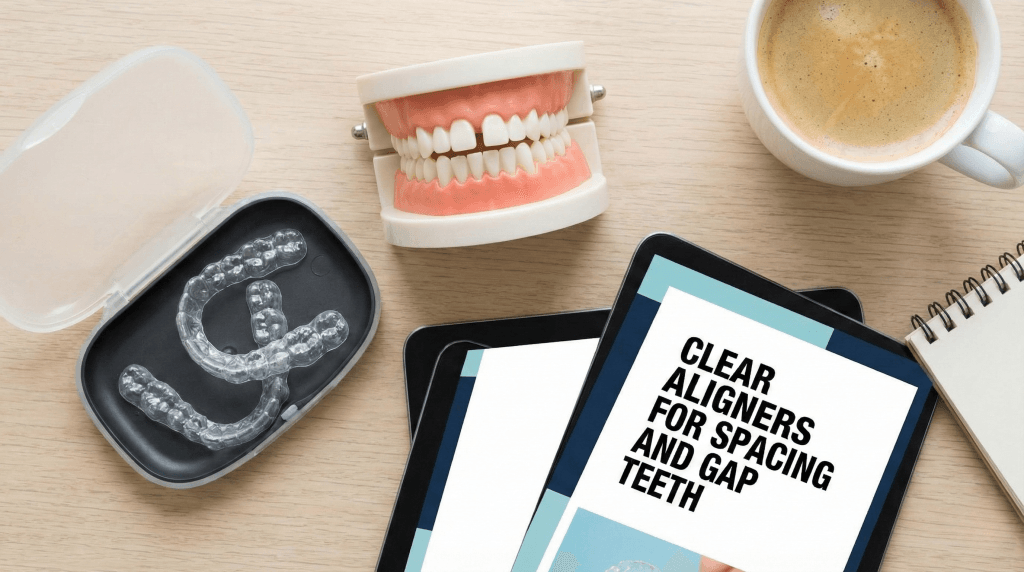
Spacing between teeth—whether it’s a small gap or noticeable spaces across the smile—can impact both appearance and oral health. Many adults and teens seek a solution that is effective, discreet, and comfortable. Clear aligners have become one of the most preferred orthodontic options for treating spacing and gap teeth without the need for traditional metal braces.
In this blog, we’ll explain why spacing happens, how clear aligners correct it, who is an ideal candidate, and what results you can expect.
Spacing issues, also known as diastema (when a gap appears between two teeth, commonly the front teeth), can occur for several reasons:
Some people naturally have smaller teeth or a larger jaw structure, leading to extra space between teeth.
When a tooth is missing or extracted, adjacent teeth may shift, creating visible gaps.
Advanced periodontal disease can weaken bone support, causing teeth to move and create spaces.
Habits developed in childhood can push teeth forward and create gaps.
When teeth are too small relative to the jaw, spacing can occur.
Regardless of the cause, spacing can affect bite alignment, speech clarity, and even increase the risk of food trapping and plaque buildup.
Clear aligners work by applying controlled, gradual pressure to move teeth into the desired position. Unlike traditional braces that use brackets and wires, aligners are custom-made transparent trays that fit snugly over your teeth.
Here’s how they correct spacing:
 Precise Digital Treatment Planning
Advanced 3D treatment planning software maps out each stage of tooth movement before treatment begins. Every aligner is designed to move teeth slightly closer together.
Gradual Closure of SpacesEach set of aligners shifts teeth incrementally. Over time, gaps become smaller until the teeth align correctly.
Controlled Force ApplicationAligners apply consistent and balanced pressure, ensuring predictable movement while maintaining comfort.
Bite OptimizationSpacing is not just about closing gaps—it’s also about ensuring proper bite alignment and functional harmony.
Clear aligners offer several benefits compared to traditional braces:
The transparent material makes them discreet, making them ideal for professionals and adults.
Aligners can be removed for eating, brushing, and flossing, maintaining better oral hygiene.
Smooth edges reduce irritation to cheeks and gums.
With digital monitoring and structured treatment plans, in-office visits are often minimized.
Modern digital simulations allow patients to preview expected outcomes before starting treatment.
Treatment duration depends on:
Size of the gap
Number of gaps
Overall bite condition
Patient compliance (wearing aligners 20–22 hours daily)
Mild spacing cases may take 4–6 months, while moderate cases can require 6–12 months. Severe spacing combined with bite issues may take longer.
Consistency is critical. Not wearing aligners as prescribed can delay results.
Clear aligners are ideal for:
Mild to moderate spacing
Front tooth gaps
Multiple small spaces
Relapse cases (teeth shifting after previous orthodontic treatment)
However, severe skeletal issues or advanced gum disease may require additional orthodontic or periodontal intervention.
A professional consultation with digital scans will determine suitability.
A 3D scan captures your dental structure accurately.
Your orthodontic plan is designed digitally, mapping tooth movement step by step.
A series of custom aligners is manufactured based on your treatment stages.
You’ll change aligners every 1–2 weeks as prescribed.
After gaps are closed, retainers are used to maintain results and prevent relapse.
Without retention, teeth can shift back over time. Wearing retainers as instructed ensures long-term stability. Retention is just as important as active treatment.
| Feature | Clear Aligners | Traditional Braces |
|---|---|---|
| Appearance | Nearly invisible | Visible brackets |
| Comfort | Smooth plastic | Metal wires may irritate |
| Removability | Yes | No |
| Hygiene | Easy to maintain | More difficult |
| Suitable for spacing | Yes | Yes |
Both options are effective, but clear aligners offer a more aesthetic and flexible solution.
Spacing and gap teeth are common concerns, but modern orthodontics offers a comfortable and highly effective solution. Clear aligners use advanced digital planning and controlled tooth movement to close gaps gradually while maintaining aesthetics and convenience.
With proper compliance and retention, patients can achieve a balanced, confident smile without the visibility of metal braces.
If you’re considering treatment for spacing or gap teeth, a professional evaluation and digital scan are the first steps toward achieving precise and predictable results.

We Provide Ortho Treatment Planning and White Label Clear Aligner Solutions.
Digital 3D Setup || Clear Aligners Manufacturer || Exporting Worldwide
