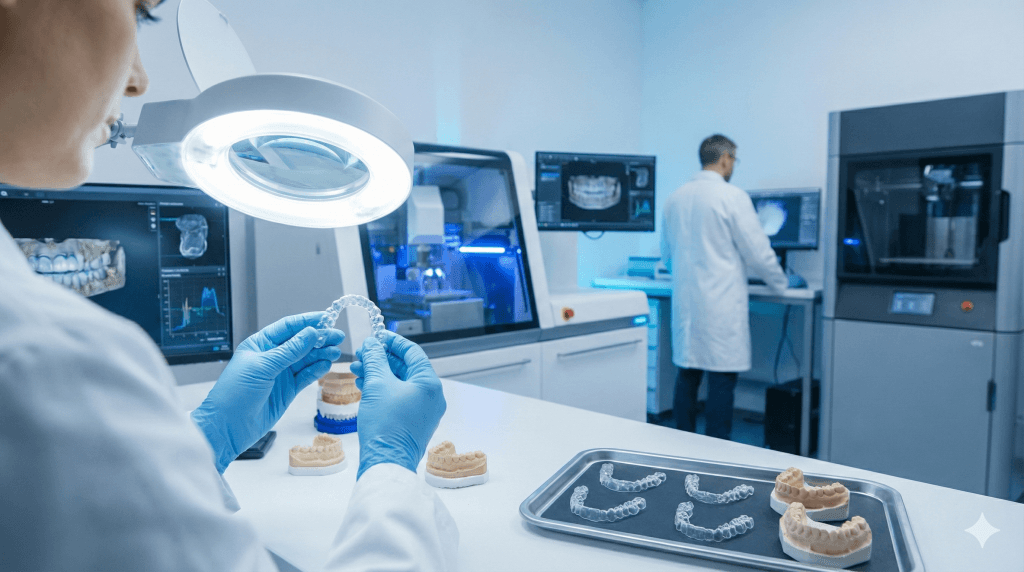
In the modern dental landscape, the clear aligner has evolved from a simple aesthetic alternative into a primary orthodontic appliance capable of complex biomechanical movements. For the treating clinician, the aligner is no longer just a piece of plastic; it is a precision-engineered medical device. When you prescribe a treatment plan, you are relying on that device to deliver specific force vectors to the periodontal ligament (PDL) with exacting accuracy.
However, a treatment plan is only as good as the appliance that executes it. The variable that often separates a predictable, successful case from a “mid-course correction nightmare” is the manufacturing quality of the aligner itself.
we view ourselves not merely as a manufacturer, but as a partner in your clinical outcomes. We understand that your reputation sits in the patient’s mouth. Therefore, we do not accept variance in the force delivery systems of our aligners. Our Quality Control (QC) protocols are designed to meet rigorous regulatory standards and support the clinical reality of your chairside work.
Below is an in-depth analysis of the validation processes that ensure our aligners perform exactly as your treatment plan dictates, minimizing refinements and maximizing practice efficiency.
The clinical success of an aligner depends heavily on its viscoelastic properties. A common failure point in generic manufacturing is using monolayer materials that suffer from rapid stress relaxation. This phenomenon occurs when the aligner material “relaxes” or permanently deforms under the constant load of the teeth, causing the force exerted on the tooth to drop below the biological threshold required for remodeling (approx. 20-26 g/cm²) within the first 48 hours.
Our Material Validation: We utilize premium multi-layer engineering polymers, such as Zendura FLX and TPU 3-Layer, which are specifically designed to combat this issue. These materials feature a dual-shell construction: a tough, chemical-resistant outer layer for durability and an elastomeric inner core for grip and elasticity.
Force Retention Testing: Our QC Department performs batch testing to validate the Initial Force (activation) and Remnant Force (retention). We ensure that the aligner maintains sufficient corrective force across the entire 7-to-14-day wear cycle.
Hygroscopic Stability: Thermoplastic materials are naturally hygroscopic (water-absorbing). In the oral environment, an aligner can absorb saliva, which may lead to swelling or warping. We test our polymers to ensure that intraoral fluid absorption does not alter the dimensional stability of the aligner. This guarantees that the precise “snap fit” achieved on insertion is maintained throughout the wear period, preventing “tracking lag.“
“Garbage in, garbage out” is a truism in digital dentistry. A manufacturing defect often originates as a digital artifact or an unrealistic movement plan. Before physical production begins, our workflow passes through stringent digital gates.
Mesh Density & Integrity: Upon receiving an intraoral scan (STL/PLY), our software analyzes the mesh density. We actively flag “micro-holes,” stitching errors from the scanner, or distortions in the molar regions that automated nesting software might ignore. Catching these digital imperfections prevents the fabrication of aligners with poor marginal fit.
Biological Feasibility: Our senior technicians run collision detection algorithms and movement validations. We verify that the programmed Interproximal Reduction (IPR) is achievable and that extrusion/intrusion movements fall within realistic biological limits. This step is crucial for preventing “aligner lag,” where the plastic demands a movement faster than the bone can remodel, leading to the dreaded “air gap” between the tooth and the aligner.
The aligner is a negative replica of a 3D-printed positive model. Therefore, the accuracy of the 3D printer directly dictates the fit of the final appliance.
We employ industrial-grade stereolithography (SLA) and DLP printers calibrated to micron-level precision.
Dimensional Accuracy: We employ a random sampling protocol where printed models are scanned and overlaid against the original CAD file. We look for deviations in the contact points and incisal edges. If a printer is drifting even slightly out of calibration, it is immediately taken offline.
Surface Texture: The resolution of the print layers (z-axis) matters. If the layers are too thick, the resulting aligner will have a “stair-step” texture inside, which can refract light poorly (making the aligner less clear) and create plaque traps for the patient. Our high-resolution printing ensures a glass-smooth surface for optimal clarity and hygiene.
One of the most overlooked aspects of aligner manufacturing is the thinning of material during the thermoforming process. When a flat sheet is heated and sucked over a tall molar or a steep canine, it stretches. If a 0.76mm sheet thins down to 0.4mm at a critical anchorage point due to improper heat distribution, the aligner loses its ability to control the tooth.
Validated Thermal Profiles: We utilize positive pressure forming with specific dwell times calibrated for each material type. We monitor the “draw ratio”—ensuring that the material thickness remains consistent over the occlusal surfaces and gingival margins.
Definition of Attachments: The efficacy of attachments (buttons/engagers) relies on the aligner wrapping sharply around them to create the active surface. Our pressure-forming process ensures crisp definition around composite attachments, ensuring the aligner “engages” fully rather than slipping over the geometry.
Patient compliance is often dictated by comfort. An aligner that impinges on the biological width or irritates the mobile mucosa leads to non-compliance (“I took them out because they hurt”).
Automated 5-Axis Trimming: We use advanced CNC milling machines that follow a calculated trim line respecting the gingival zenith. We validate the offset to ensure the aligner extends exactly to the planned margin. This optimizes retention (by utilizing the undercut of the clinical crown) without impinging on the gingiva.
Micro-Polishing & Deburring: A cut plastic edge is naturally sharp. Our finishing protocol includes a multi-stage tumbling process followed by a magnified visual inspection to eliminate micro-burrs. This attention to edge smoothness drastically reduces the likelihood of iatrogenic soft tissue trauma, minimizing emergency visits for “sharp spots” or ulcerations.
For the dental professional, liability and safety are paramount. In an era of direct-to-consumer options and offshore white-labeling, you need to know that the device you are inserting into a patient’s mouth is safe and fully traceable.
UDI Serialization: Every Clear Moves aligner is laser-marked with a unique identifier. This serialization allows us to trace the full genealogy of the device: the specific batch of raw resin used, the technician who designed the plan, the specific 3D printer used for the mold, and the operator who performed the final polish.
Regulatory Rigor: Our facility operates under strict ISO 13485 medical device standards. This means our quality management system is audited and verified. In the unlikely event of a material recall or adverse event, we have immediate access to all data points required for regulatory reporting, protecting your practice from liability.
Despite all our automation and AI-driven validation, we believe there is no substitute for the trained human eye.
Before packaging, every aligner undergoes a physical fit assessment. Technicians place the finished aligner back onto its corresponding 3D model to verify the “snap fit.” This confirms that no distortion occurred during the cooling or polishing phases. If the aligner rocks, lifts, or does not seat fully with a tactile “click,” it is rejected.
Why does this level of manufacturing rigor matter to your bottom line?
Reduced Refinement Rates: Accurate force delivery means teeth move as predicted, reducing the need for mid-course corrections and additional scans.
Lower Chair Time: A better fit means less time adjusting tracking issues, buffering rough edges, or managing emergency comfort visits.
Higher Patient Satisfaction: A premium, clear, and comfortable appliance reflects the high standard of care you provide, leading to more referrals.
we are your partners in precision. Our commitment to strict quality control allows you to focus on what you do best—diagnosing and treating—with the confidence that the appliance will deliver the results you promised.
© 2026 Clear Moves Aligners All Rights Reserved 8 core digital marketing agency