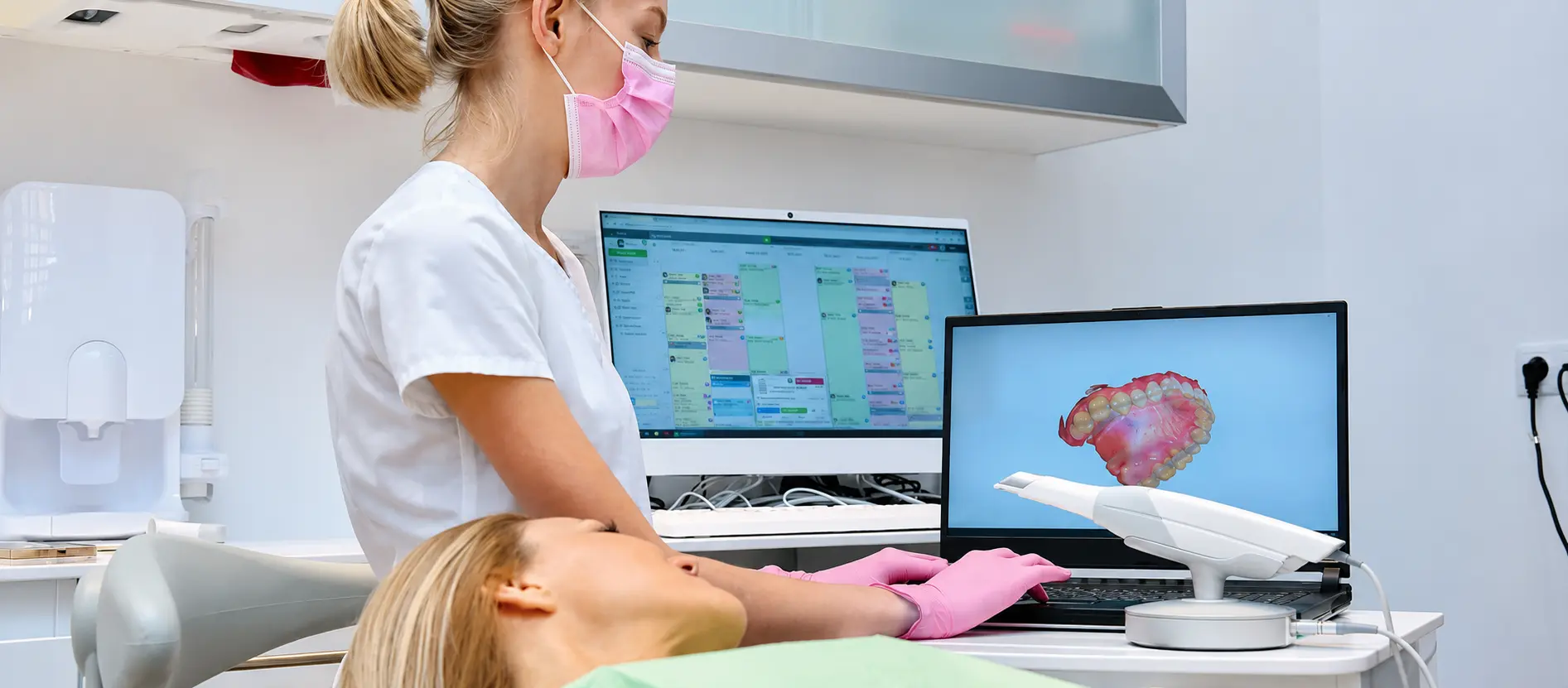
If you want to reduce clear aligner refinements, the work starts long before a tray reaches the patient's mouth. Refinements aren't an inevitable side effect of aligner therapy — they're a signal that something in the planning, staging, or biomechanics didn't perform as predicted. And the data is consistent: most refinements stem from preventable planning decisions, not biological surprises.
This guide walks through the 3D treatment planning principles, diagnostic protocols, and clinical-lab collaboration patterns that high-performing orthodontists use to drive refinement rates well below industry averages. The goal isn't zero refinements — it's predictable, controlled treatment outcomes that protect chair time, preserve case profitability, and keep patients in finished retention on schedule.
Why Clear Aligner Refinements Hurt Your Practice
Every refinement case carries a stack of hidden costs that compound across a practice. The per-case lab fee is the easiest number to see, but it's rarely the biggest one. Each refinement triggers a fresh records appointment, a new digital scan, a re-planning cycle, additional chair time for attachment changes, and extended wear time that pushes finishing further away.
For a practice running 200 aligner cases a year at a 50% refinement rate, that's 100 unplanned re-planning cycles. At even a conservative two hours of combined clinical and admin time per refinement, you're absorbing 200 hours of unbillable work — the equivalent of a part-time staff member dedicated to fixing cases that should have finished on the first plan.
There's also a patient experience dimension that's harder to quantify. Patients who learn their treatment will take longer than projected often perceive it as a clinical failure rather than a planned course correction — even when the additional refinement is clinically minor. That perception affects reviews, referrals, and case acceptance for future patients.
The Root Causes of Aligner Refinement Cases
Before fixing the refinement problem, it's worth being precise about what's actually causing it. Across thousands of cases reviewed in our lab, refinement triggers cluster into a handful of repeat offenders — and the majority are planning issues, not patient issues.
Inadequate diagnostic records
Scans with bubbles, missing distal molars, incomplete bite registration, or no CBCT for cases that require root visualization all force the planning software to extrapolate. Extrapolation introduces drift, and drift becomes refinement.
Overly optimistic staging
Asking 0.35mm of bodily movement per tray on a canine retraction case, or planning a 4mm anterior intrusion across 14 trays, ignores well-documented expression limits. The software allows it. The biology doesn't.
Poor attachment design and placement
Missing attachments on rotations that need them, optimized attachments placed on inadequate tooth surface area, or attachments scheduled to appear at the wrong stage all degrade tracking. Each missed gram of force compounds across trays.
Underestimating root movement difficulty
Crown tipping is easy. Root movement is hard. Treatment plans that show beautifully aligned crowns but ignore root parallelism, torque expression, or root resorption risk frequently come back for refinement once panoramic radiographs reveal the disconnect.
Patient compliance assumptions
22 hours of daily wear is a clinical assumption, not a guarantee. Plans that build in no compliance buffer — no overcorrection, no recovery flexibility — will under-track on any patient who averages 18–20 hours.
- Planning errors: The largest avoidable category — overly aggressive staging, missing attachments, ignored biomechanical limits.
- Diagnostic gaps: Poor scans, missing CBCT, no functional analysis on bite-affecting cases.
- Biological variability: Unpredictable bone density, ankylosed teeth, periodontal response — genuinely difficult to predict but a smaller share than most clinicians assume.
- Compliance gaps: Real but often overstated — strong planning absorbs minor wear-time deviation.
How 3D Treatment Planning Reduces Refinements
The shift from analog to digital orthodontics gave clinicians an extraordinary tool: the ability to model an entire treatment sequence before a single tray is printed. Used rigorously, 3D treatment planning lets you stress-test a case, identify weak movements, and revise the plan in software rather than in the patient's mouth.
The clinicians with the lowest refinement rates treat the digital setup as a clinical workspace, not a preview. They iterate. They question the software's default staging. They map every planned movement against published biomechanical limits. And they treat virtual setup review as a structured clinical decision, not a rubber stamp.
Predictive movement modeling
Modern planning platforms can flag movements that exceed safe per-tray velocities, identify collisions during sequencing, and visualize root positions in three dimensions. Most clinicians use only a fraction of this functionality. Refinement-conscious clinicians use all of it — and they treat any flag as a planning failure to resolve, not a warning to override.
CBCT integration
For cases with periodontal risk, planned expansion, or significant root movement, integrating CBCT data into the digital setup is a game-changer. It lets you see where roots are relative to cortical plates and prevents the most damaging refinement triggers: planned movements that the bone simply will not accept.
Iterative virtual setup revision
The first staging the software produces is almost never the right one. Lab partners that build in structured revision rounds — clinician marks up the proposed plan, lab returns a revised version, repeat — produce dramatically lower refinement rates than single-pass workflows. If your current process is "approve and print," that's a major leverage point.
The Pre-Treatment Diagnostic Workflow That Prevents Refinements
Every refinement-resistant treatment plan starts with diagnostic records the planning software can actually trust. Cutting corners here is the single most common reason a case that looked perfect on screen unravels in tray six.
- Complete intraoral scanFull arch, all molars captured, no scan holes, accurate bite registration. Re-scan if any segment is incomplete — patching in software introduces predictable error at the location that matters most.
- CBCT for complex casesPeriodontally compromised patients, planned expansion greater than 2mm, significant torque changes, or any case with root resorption history. CBCT lets the setup respect bone, not just enamel.
- Periodontal assessmentProbe depths, attachment levels, mobility, and recession should be documented before staging is built. Aggressive movement planned over a thin biotype is a refinement waiting to happen.
- Functional analysisCentric relation, working and balancing contacts, joint sounds, parafunction. Treatment that disregards function will come back — either as a refinement, or as a retreatment two years later.
- Photographic seriesExtraoral and intraoral photographs in standard views give the lab clinical context the scan alone can't communicate: smile arc, facial asymmetry, lip competence.
- Treatment objectives in writingDocument the clinical goals — not just "straighten the teeth" but specific outcomes: Class I canine, 2mm overjet, 20% overbite, midlines coincident. The lab plans against your objectives, not its own assumptions.
Practices that treat this workflow as a clinical protocol — not an administrative checklist — see refinement rates drop in the first quarter of implementation. The single highest-leverage improvement most practices can make is requiring re-scans for any record with capture issues, even when the patient is mid-appointment.
Tighten Your Refinement Rate
Submit a case for clinical review and see how a refinement-aware 3D treatment plan compares to your current workflow.
[email protected]Designing Aligners for Predictable Tooth Movement
Once diagnostics are clean, the planning challenge becomes biomechanical: how much movement can you ask of each tooth per tray, and which movements need overcorrection to express clinically? Getting this hierarchy right is what separates plans that finish on the first try from plans that need a refinement at the halfway mark.
Per-tray movement limits
The published consensus values are well-known but routinely violated by default staging: roughly 0.25mm of linear movement, 2–3° of rotation, and conservative caps on extrusion and torque expression per tray. Plans that exceed these consistently produce tracking loss, particularly in the canine and premolar regions where rotation is biomechanically difficult.
The difficulty hierarchy
Not all movements are created equal. From easiest to hardest in clear aligner therapy: crown tipping, mild rotation of incisors, mesiodistal translation, extrusion of incisors, rotation of canines and premolars, bodily movement, root uprighting, posterior extrusion, and significant torque change. Planning that assumes uniform expression across all movement types will systematically under-deliver on the hardest categories.
Strategic overcorrection
For predictably under-expressing movements, building 20–30% overcorrection into the digital setup pre-compensates for the expected loss. The mistake to avoid: overcorrecting easy movements you don't need to. The plan should look surgical, not panicked — targeted overcorrection on the movements that biology resists.
Staging philosophy
Sequencing matters as much as magnitude. Plans that try to do everything everywhere at once produce force conflicts and tracking loss. Sequential staging — leveling and aligning first, then space management, then detailed finishing — gives each phase room to express before the next begins.
| Movement Type | Difficulty | Per-Tray Limit | Overcorrection |
|---|---|---|---|
| Crown tipping (incisors) | Low | 2.5° per tray | Not typically needed |
| Rotation (incisors) | Low–moderate | 2° per tray | 10–15% on round-rooted teeth |
| Rotation (canines, premolars) | High | 1.5° per tray | 20–30% recommended |
| Extrusion (anterior) | High | 0.25mm per tray | 25–30% recommended |
| Posterior extrusion | Very high | Often unachievable without auxiliaries | Plan auxiliaries from start |
| Root uprighting | High | 1.5° per tray | 20% plus attachment |
| Bodily translation | High | 0.20mm per tray | 15–20% plus attachment |
Strategic Use of Attachments and IPR in Treatment Planning
Attachments and interproximal reduction are the two clinical levers that most directly determine whether a digital plan tracks in the real world. Both are routinely under-planned in software defaults — and both are major refinement drivers when they're handled poorly.
Attachment design fundamentals
An attachment exists to translate aligner force into a specific tooth movement the plastic can't generate on its own. Rotations of round-rooted teeth need horizontal attachments with the right gingival-incisal placement. Extrusions need optimized extrusion attachments — and they need them on adjacent teeth as anchorage. Root uprighting needs vertical rectangular attachments positioned to apply the necessary moment.
The most common attachment mistakes are: omitting them where biomechanics demand them; placing them on teeth with inadequate clinical crown height; scheduling their appearance at the wrong tray; and using default optimized attachments without confirming the underlying movement is actually within their design envelope.
IPR planning and timing
Interproximal reduction is more than a space-creation tool — it's a sequencing decision. IPR planned too early creates open contacts that destabilize anterior alignment. IPR planned too late means crowding never resolves. The right approach is to plan IPR in synchronized stages with the alignment that needs it, and to keep individual sites at clinically safe amounts: typically no more than 0.3mm per contact, with total arch IPR rarely exceeding 4–5mm without a strong justification.
Monitoring and Mid-Course Corrections Before Refinement
Even the best plan needs verification in the patient's mouth. The fastest way to reduce full refinements is to catch tracking failures while they're still small enough to correct without a new scan and a new plan.
The 6-week checkpoint
By tray four to six, any significant tracking loss is usually visible — gaps between tooth and aligner, rotations that haven't expressed, missing attachment engagement. A structured in-office or remote-monitored review at this stage gives you a small intervention window: extending wear time on the current tray, adding a button or chair-side composite, or backing up one stage to recover engagement.
Remote monitoring
Photo-based remote monitoring platforms have matured into a reliable early warning system, particularly for distance-sensitive practices. They flag tracking deviations before the patient or clinician would catch them in person, and they create a data trail that supports cleaner refinement decisions when one is genuinely needed.
Recovery sequences vs. full refinement
Not every tracking issue requires a full refinement. A short recovery sequence — a handful of trays designed specifically to recapture lost movement — often resolves what would otherwise become a 20-tray refinement case. The decision tree should always start with the question: "Can this be recovered without a new scan?"
Choosing a Lab That Supports Refinement-Free Outcomes
The software is only part of the equation. The lab that turns your digital setup into trays — and the clinical team that reviews your plan before printing — has more influence on your refinement rate than any single piece of technology. The right partner functions as a clinical extension of the practice, not a fulfillment center.
When evaluating a lab partner, the questions worth asking go beyond price and turnaround. Does the lab employ in-house orthodontic reviewers, or does it just press "print" on whatever the clinician submits? How many structured setup revision rounds are included by default? Will the lab push back on overly ambitious staging? Can the lab integrate CBCT data into the planning workflow? What's the documented refinement rate across the lab's case mix?
At Clear Moves Aligners, our planning workflow is built around refinement prevention as a first-class objective. Every case is reviewed by an in-house clinical specialist before staging is finalized, with structured revision rounds available on every plan and CBCT integration supported across our manufacturing pipeline. Our team works with orthodontists across the United States and internationally, and our clinical partnership model is designed for practices that want a lab to flag risks before trays are printed — not after the refinement scan arrives.
- In-house clinical reviewers: Real orthodontic eyes on every case before manufacturing, not algorithmic approval.
- Structured revision rounds: Multiple iteration cycles included by default, with clear timelines.
- Willingness to push back: A lab that says "this staging will under-express" is worth more than one that prints whatever you submit.
- CBCT integration: The ability to plan against root and bone data, not just crown surfaces.
- Transparent refinement data: A partner that tracks and shares refinement rates across its case mix.
- Documented turnaround SLAs: Predictable timelines for setups, revisions, and tray production.
Reducing refinements isn't about a single tool, software upgrade, or protocol change. It's about treating the entire pre-treatment workflow — diagnostics, planning, staging, attachments, IPR, lab review — as one continuous clinical decision rather than a series of handoffs. The practices with the lowest refinement rates have systematized that workflow. The practices with the highest rates have left it to the default settings.
Frequently Asked Questions
What is considered a normal refinement rate for clear aligners?
Can refinements be eliminated entirely with better 3D planning?
How does CBCT improve clear aligner treatment planning?
What role do attachments play in reducing refinements?
How early should I identify tracking issues to avoid a full refinement?
Should I overcorrect tooth movements in the initial treatment plan?
What should orthodontists look for in a clear aligner lab partner?
Worldwide

Build Predictable Cases From Day One
Partner with a lab that flags treatment risks before trays are printed. Our setups are built around refinement prevention, not reaction.
[email protected]